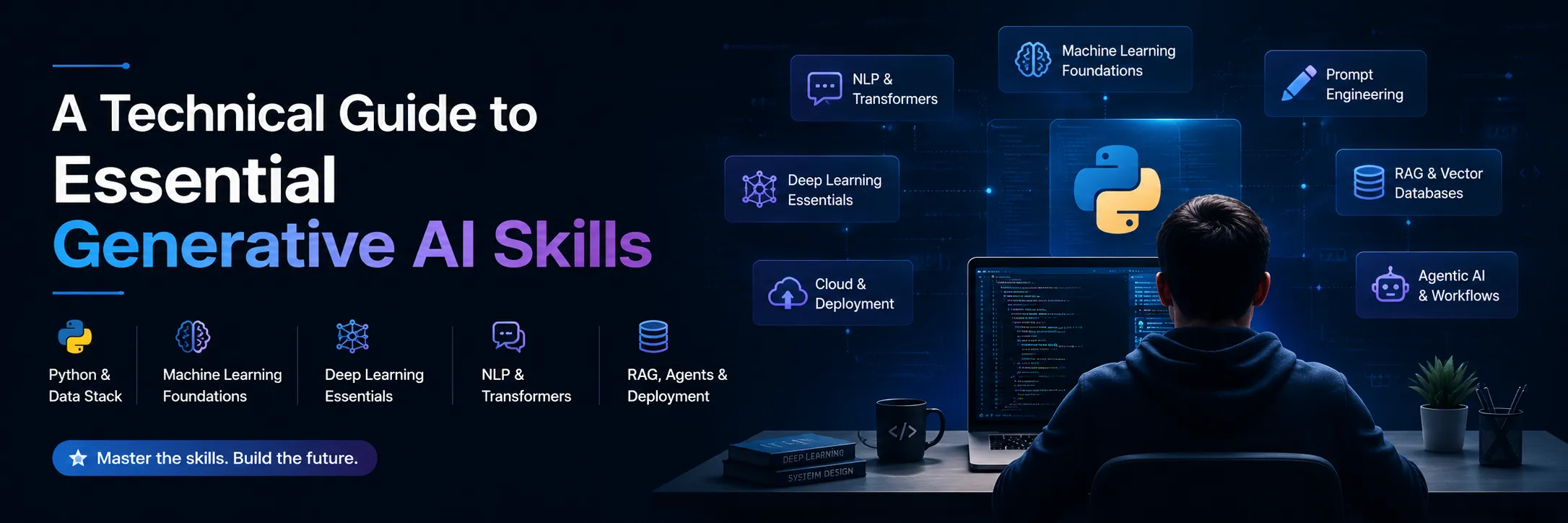
A Technical Guide to Essential Generative AI Skills
In 2026, Generative AI is no longer a tech innovation; it has evolved as a core business growth tool, driving competitive gains. From content designing to product prototyping, GenAI has established its presence in all aspects. Thus, the demand for GenAI practitioners has increased in 2026, creating a new hiring trend for professionals. However, anyone eager to build a successful AI career in 2026 should focus on gaining essential generative AI skills.
AI hiring in 2026 is not about filling the talent gaps. By 2026, almost 90% firms are using AI in their daily operations. Hence, professionals with cutting-edge GenAI skills can only survive the AI dominance.
This is a structured deep dive into the foundations that every serious GenAI practitioner needs to master — from data structures and ML principles to transformer architectures, prompt engineering, and agentic pipelines.
Quick Navigation: What you'll learn in this guide
Here is a quick navigation into the core technical foundations that every GenAI practitioner should master to stay competitive in their careers. This guide will introduce you to essential GenAI skills, from Python and data stack to the end-to-end ML lifecycle.
1. Python & the Data Stack
Indeed, Python for Generative AI practitioners is no longer a choice; instead, it has become a starting point for professionals. Today, every LLM, RAG pipeline, agentic workflows, etc., run with Python.
In short, Python has become a baseline for every AI innovation, and GenAI is no different. Yet, many professionals fail to grasp every bit of Python intricacies that shouldn’t be avoided if you’re trying for GenAI practitioner roles.
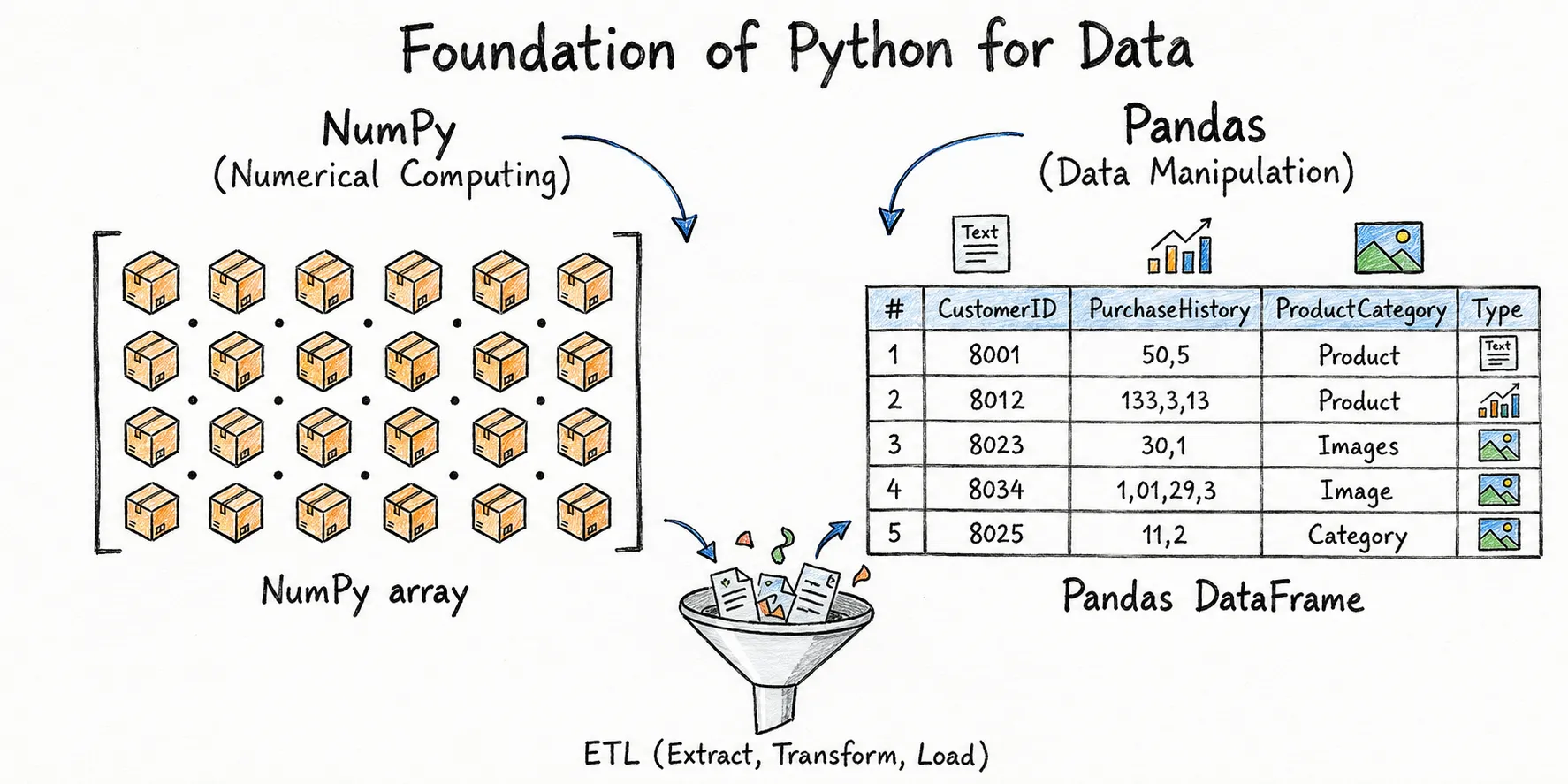
Python is the lingua franca of modern AI. Before touching any model, you need fluency in its core constructs: lists, dictionaries, sets, and tuples; control flow via loops and conditionals; and functions, including the concise lambda syntax.
Two libraries underpin almost everything else in the ecosystem:
• NumPy — Numerical computing. Arrays, vectorised operations, and the mathematical substrate every ML framework builds on.
• Pandas — Data manipulation. DataFrames, CSV/Excel I/O, and the ETL layer for cleaning real-world datasets before they reach a model.
Python for Generative AI practitioners has become the most debatable topic for professionals eager to revamp their careers in 2026. Hence, enrolling in an Applied AI Practitioner Program can help you master essential skills and thrive.
2. Machine Learning Foundations
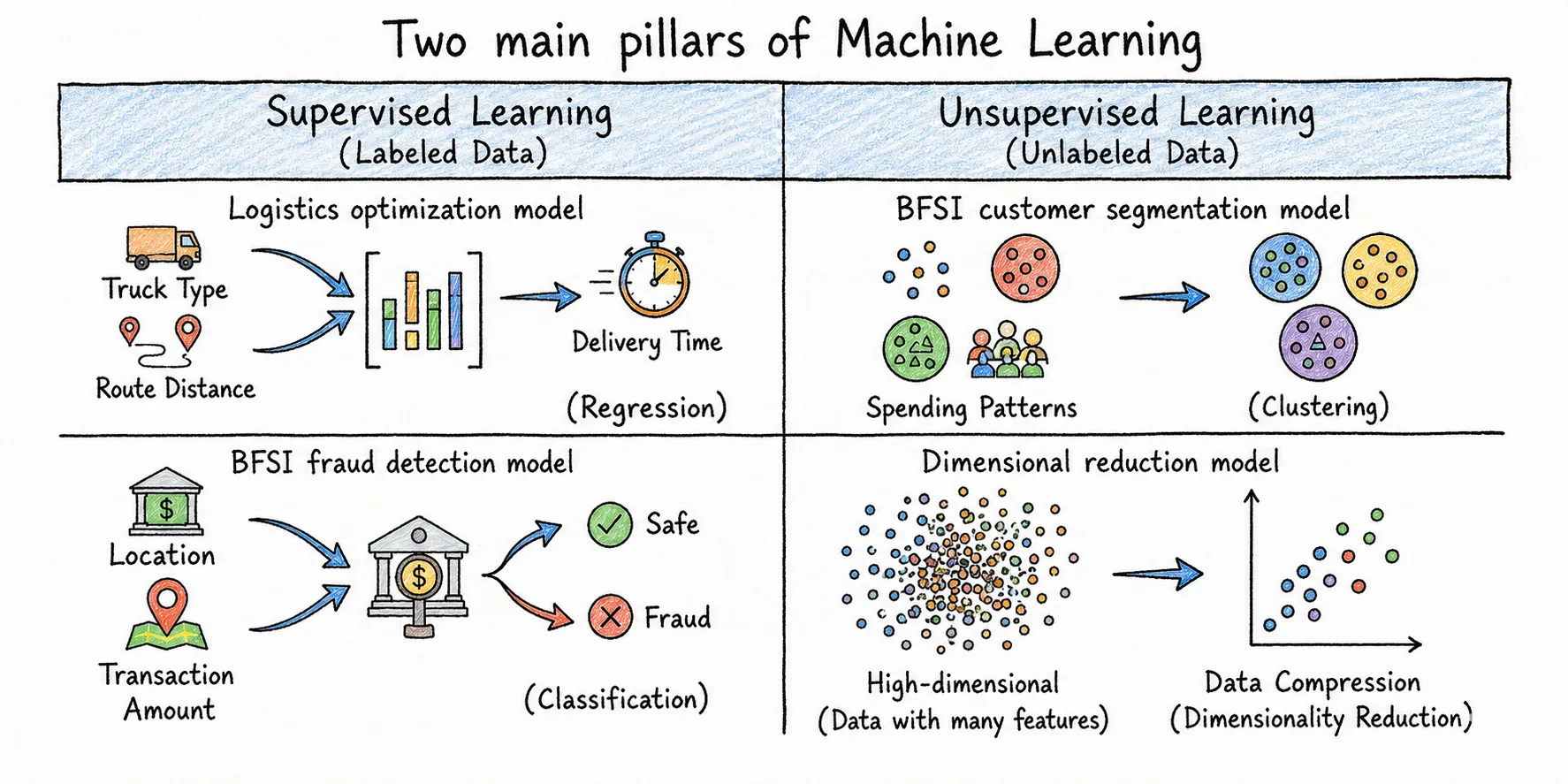
Supervised Learning
Models trained on labelled data to predict a target variable. Two broad task types:
• Regression — continuous outputs (e.g. house prices, temperature). Key algorithms: linear regression, k-NN, decision trees, and ensembles like Random Forest, XGBoost, LightGBM.
• Classification — discrete labels (spam vs. ham, churn prediction). Adds logistic regression, SVM, Naïve Bayes, and gradient-boosted trees to the toolkit.
Unsupervised Learning
No labels — the algorithm discovers structure. Core techniques include:
| Technique | Representative Algorithms | Typical Use Case |
|---|---|---|
| Clustering | k-Means, DBSCAN, GMM, Hierarchical | Customer segmentation, anomaly detection |
| Dimensionality reduction | PCA, t-SNE, LDA, SVD | Preprocessing before deep learning pipelines |
| Recommendation | Collaborative filtering, content-based, hybrid | E-commerce, streaming platforms |
| Association rules | Apriori, FP-Growth | Market-basket analysis |
| Generative models | GANs, VAEs, Diffusion models, Autoencoders | Image synthesis, data augmentation |
Distance & Similarity Metrics
Core to k-NN and all clustering algorithms: Euclidean distance, Manhattan distance, cosine similarity, and Hamming distance for binary vectors. Cosine similarity reappears critically in RAG retrieval — a high cosine value between two embedding vectors means they share semantic meaning.
Evaluation Metrics
| Task | Metric |
|---|---|
| Regression | MSE, RMSE, MAE |
| Classification | Accuracy, Precision, Recall, F1, AUC-ROC |
| Clustering | Silhouette score, Elbow method |
| Text generation | BLEU, ROUGE, ChrF, Perplexity |
3. Deep Learning Essentials
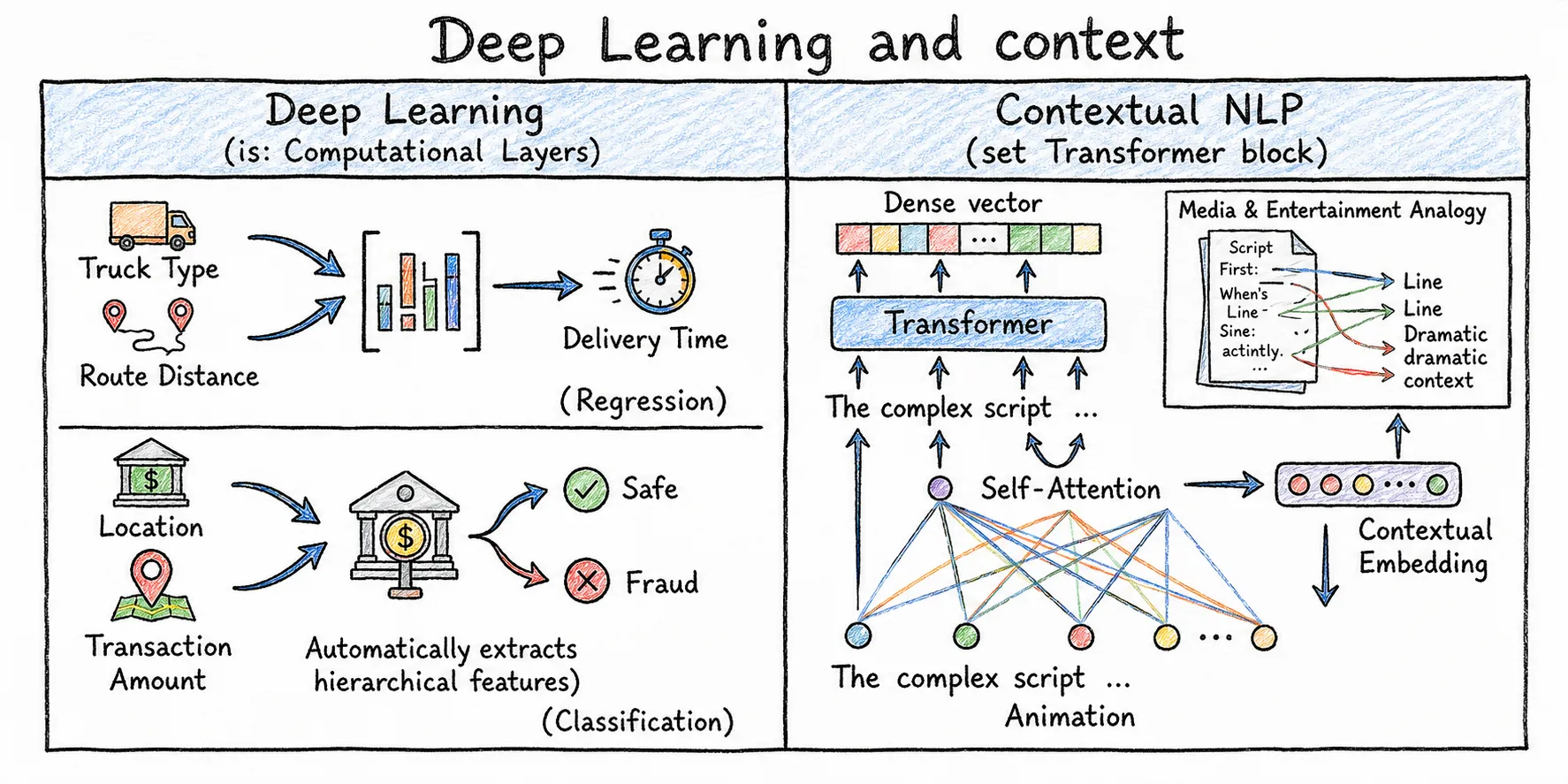
The artificial neuron computes a weighted sum of its inputs and passes the result through an activation function: output = σ(Σ wᵢxᵢ + b)
where σ is a nonlinearity such as ReLU, sigmoid, or tanh. Stack many such layers, and you have a deep neural network. Key concepts:
• Optimisation: gradient descent variants (mini-batch, momentum), Adam, RMSprop.
• Regularisation: dropout and L2 penalty to prevent overfitting.
• Batch normalisation: stabilises and accelerates training by normalising layer inputs.
• Back-propagation: chain-rule calculus for propagating gradients and updating weights.
CNNs extend this framework to grid-structured data like images via convolution operations, pooling, and learned feature hierarchies — the architecture underpinning computer vision before and alongside the transformer era.
4. Natural Language Processing
NLP sits at the heart of every LLM-based system. It is one of the most essential generative AI skills that every professional should master. Understanding it at three levels is essential:
Level 1 — Basic language model: Token-prediction, n-gram approaches. Simple probabilistic modelling of word sequences.
Level 2 — Distributed language model: Embeddings (Word2Vec, GloVe, FastText). Dense vectors that capture semantic similarity between tokens.
Level 3 — Large Language Model: Transformer-based (BERT, GPT). Full contextual understanding — handles sarcasm, idioms, emojis, and long-range dependencies. Fine-tuned with RLHF for alignment.
NLP Pipeline
Raw text → text cleaning(remove noise: punctuation, slang, emoji) → vectorisation(TF-IDF, embeddings) → model input. Machines operate on numbers; vectorisation is the bridge from language to linear algebra.
Embedding Models Timeline
| Word2Vec | 2014 (Google) | Predict surrounding words → dense embeddings |
| Glove | 2014 (Stanford) | Global word co-occurrence matrix |
| FastText | 2016 (Meta) | Sub-word information → better OOV handling |
5. Generative AI Architecture
Generative AI is the sub-domain of AI that produces novel content — text, images, audio, video — from a prompt. The Attention Is All You Need paper (2017) introduced the transformer architecture that made this possible at scale. Professionals with an in-depth knowledge of top generative AI skills can accelerate their careers in 2026.
Major Model Families
| Provider | Text Generation | Image / Video / Audio |
|---|---|---|
| OpenAI | GPT-3.5, GPT-4, GPT-4.1, GPT-5 | DALL·E, Sora (video), TTS |
| Gemini series | Imagen, AudioLM | |
| Meta | LLaMA family | — |
| Anthropic | Claude series | — |
Image Generation Lineage
GANs → VAEs → Latent Diffusion → Stable Diffusion v1–3 → DALL·E 2 → Flux
Diffusion models dominate current image synthesis: they iteratively denoise a random vector until a coherent, high-fidelity image emerges — a process guided by a text embedding at each step.
Architecture Progression
RNNs and LSTMs handled sequences with recurrence but suffered from vanishing gradients and serial computation. Transformers replaced recurrence entirely with self-attention — allowing every token to attend to every other token in parallel, scaling far more effectively to large corpora and large context windows.
Indeed, the emerging role of Generative AI inspires professionals to master essential skills and excel in their careers.
6. Prompt Engineering
According to Fortune Business Insights, the global prompt engineering market is expected to grow by 33.27% by 2034, becoming an essential skill in the GenAI age.
A prompt is the input token sequence that steers a model's generation. Well-designed prompts are as important as model selection. Four design principles:
• Clarity — Explicit instructions. Eliminate ambiguity; the model generates whatever fits.
• Context — Provide domain-specific background or few-shot examples to anchor the generation.
• Constraints — Specify format, length, and style. Structured outputs improve reliability.
• Iterative refinement — Tune temperature and top-p decoding parameters. Test; adjust; repeat.
Decoding parameters matter: temperature controls randomness (0 = deterministic, 1+ = creative), while top-p (nucleus sampling) limits the token pool to the most probable mass, reducing hallucinations.
7. RAG, Evaluation & Guardrails
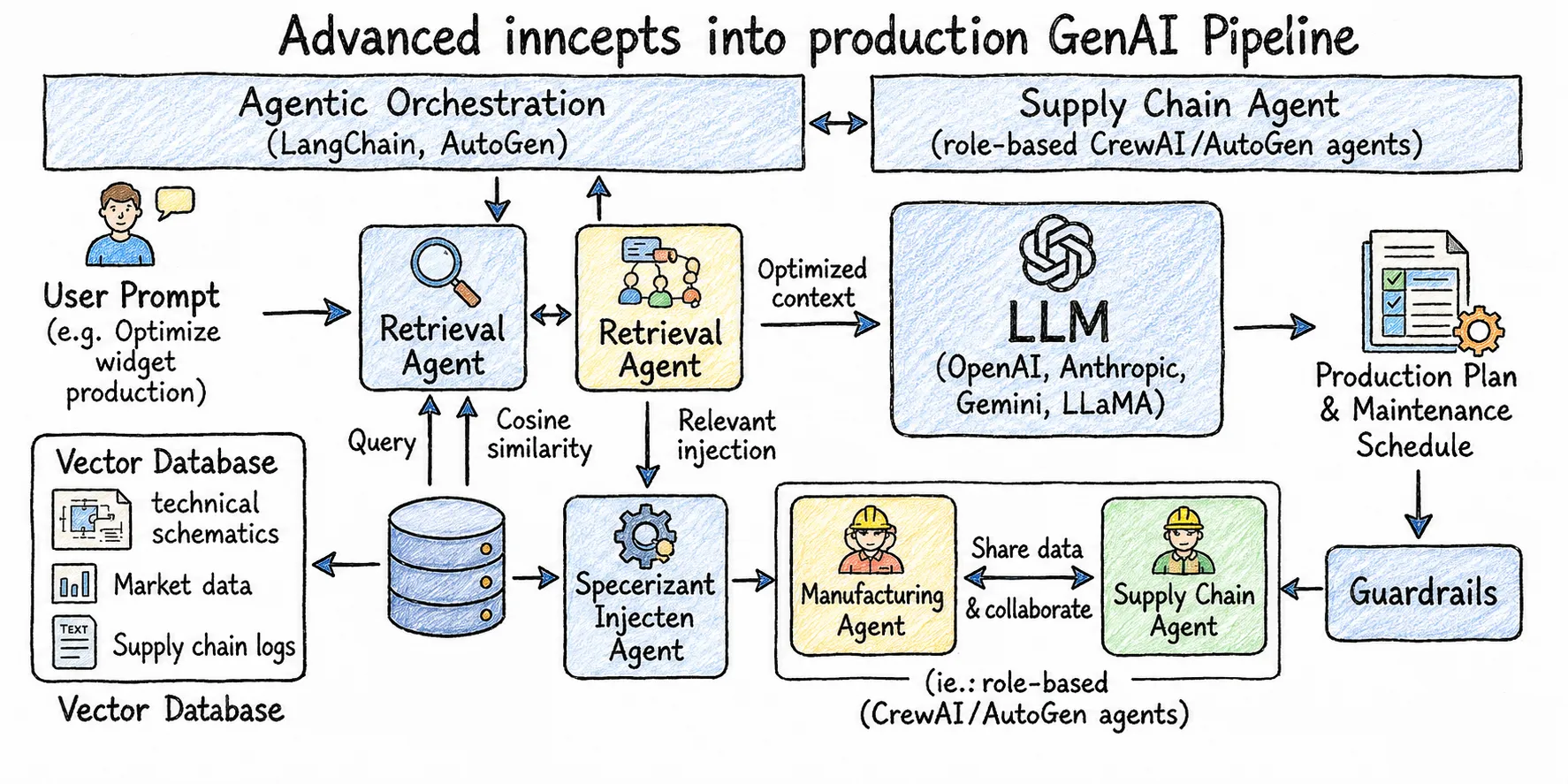
Retrieval-Augmented Generation (RAG) addresses a core LLM limitation — static training knowledge. A RAG pipeline embeds a corpus, stores vectors in a vector database, and retrieves the top-k most semantically similar chunks (via cosine similarity) at inference time, injecting them into the prompt as context before generation.
| Task | Metric |
|---|---|
| Classification | Accuracy, Precision, Recall, F1, AUC-ROC |
| Text generation quality | BLEU, ROUGE, ChrF, Perplexity |
| Image generation quality | FID (Fréchet Inception Distance), Inception Score |
| Safety & robustness | Prompt-injection tests, jailbreak probes |
Guardrails are rule-based or learned constraints layered on top of a model to prevent harmful, biased, or off-policy outputs — the ethical and safety layer of every production GenAI system. Experts with proven GenAI skills can acknowledge these guardrails and act proactively.
8. Orchestration Frameworks & Agentic Pipelines
Orchestration frameworks and agentic pipelines are crucial generative AI skills that professionals should consider learning.
Production GenAI applications rarely call a model once. They chain calls, retrieve context, delegate to specialised agents, and manage state across turns. Four frameworks cover the main patterns:
| Framework | Primary Abstraction | Typical Companion |
|---|---|---|
| LangChain | Chaining LLM calls with data sources | Retrieval, memory, prompts |
| LangGraph | Graph-based workflow orchestration | Complex multi-step pipelines |
| AutoGen | Automatic agent collaboration | Multi-LLM chat orchestration |
| CrewAI | Role-based team of agents | Simulating organisational tasks |
These frameworks sit above the raw API layer, handling memory, tool use, and multi-agent coordination so practitioners can focus on application logic rather than plumbing.
Professionals can master Agentic AI frameworks to future-proof their careers and land promising GenAI practitioner roles in 2026.
9. Cloud Deployment Platforms
• AWS Bedrock — Managed LLM endpoints; rapid prototyping and easy scaling without infrastructure management.
• Azure OpenAI — Direct access to GPT-4 and DALL·E via Microsoft's enterprise-grade security layer — integrates naturally with the Microsoft 365 ecosystem.
• GCP Vertex AI — End-to-end ML pipelines plus Vertex Search for vector database integration — suited for teams that need both training infrastructure and production serving.
Aspirants can also opt to pursue an AI-powered Cloud & DevOps master's program to learn about various deployment platforms.
10. The End-to-End ML Lifecycle
1. Data collection — client data, public repositories (Kaggle, UCI), web scraping.
2. Exploratory Data Analysis — univariate, bivariate, and multivariate statistics.
3. Data preparation — cleaning, missing-value handling, outlier treatment, feature engineering, imbalance mitigation, and embedding generation.
4. Model building — algorithm selection per task type.
5. Evaluation — apply task-appropriate metrics; hyperparameter tuning.
6. Deployment — cloud or on-premise serving with latency monitoring and drift detection.
Deep learning automates feature extraction — CNNs for images, Transformers for text — and typically runs on GPUs. Classical ML relies on manual feature engineering and CPU-based libraries. Both remain relevant depending on scale, interpretability requirements, and available compute.
A guide to a Generative AI learning path for various professionals can be helpful for you to know what exactly works for you.
Conclusion
GenAI practitioners in 2026 should master crucial generative AI skills to set themselves apart from generalists. In addition, the latest hiring trends inspire professionals to master technical foundations to enhance human judgment and tackle challenges.
No wonder mastering Python for Generative AI practitioners, ML, agentic platforms, etc., is a compounding investment. The practitioners with real-time knowledge of data stack, deep learning fundamentals, GenAI architecture, NLP, prompt engineering, RAG, cloud deployment, and ML lifecycle will thrive in future.
For in-depth knowledge-building, you can enrol in Learnbay’s Generative AI and Agentic AI Master Program for Working Professionals.
FAQs:
Is Python enough to get a generative AI job in 2026?
Ans. No. Mastering Python for generative AI jobs is essential for working professionals in 2026, but alone, it’s not enough. Anyone eager to drive competitive growth in GenAI jobs should first learn Python, followed by other technical foundations. Apart from Python, you should also learn the following skills to thrive –
• ML algorithms
• Deep Learning
• NLP
• GenAI architecture
• Prompt engineering
• RAG
• Agentic pipelines
• Cloud deployment with GenAI
What is a RAG pipeline, and why do GenAI interviews ask about it?
Ans. A RAG pipeline is an AI framework that extracts useful data from external sources and instils them into LLMs. GenAI interviews ask about RAG because it is one of the most crucial architectural GenAI skills that everyone should learn. RAG-related questions help interviewers to –
• Assess your real-time experience
• Help you address LLM pitfalls
• Analyse system design skills
• Gain an in-depth knowledge of the AI stack
Can working professionals learn generative AI while doing a full-time job?
Ans. Yes. Working professionals can easily manage GenAI learning while doing a full-time job and land ideal jobs. A strategic learning guide can help experts master essential generative AI skills, work on projects, apply them in real-time, certify them, and land promising jobs.