Why Has Generative AI For Deepfake And Synthetic Data Been So Popular Till Now?
Artificial Intelligence (AI) has made tremendous leaps in recent years. Its groundbreaking innovations bring Generative AI to the spotlight. Gen AI has become one of the most fascinating topics these days, with a developing trend. Gradually, Gen AI has surprised us with splendid creations that rule across the modern business world.
In the interim, we are introduced to an advanced form of Gen AI known as Deepfake technology. This advanced creation has sparked a buzz around fake image or video generation, posing endless threats. Modern business spaces face fake and manipulated formations, driving huge losses.
Briefing on the Emerging Role of Generative AI
Deep learning algorithms are advancing rapidly, and their role is becoming increasingly pervasive, leading some experts to refer to this as "GenAI." This concept is already in use in optimization techniques, for example. All of this, however, is only the beginning of this technology, which is expected to undergo many more modifications in the future. So, much more in the future, resulting in products and services that we can only imagine in sci-fi tales.
Deepfakes and Gen AI are at the core of most tech controversies right now. The rise of synthetic media poses significant risks across diverse industries. Such creations can fake a user’s face, change facial features, and synthesize various scenarios for unethical motives.
Indeed, strong governing principles and practices have become an urgent requirement for users. Experts are encouraged to incorporate AI ethics practices into their existing operations for resilient results.
Synthetic Data- What Does it Mean?
Let's look at synthetic data, its different forms, and how these models are employed in business, hampering its privacy.
Synthetic data is a relatively new concept. It refers to the practice of creating a secure replica of an image, video, or audio file, ensuring complete security. Experts use deep learning algorithms and simulations to replicate real-world scenarios with enriched data safety.
In recent years, AI applications such as image recognition, text generation, and speech recognition have grown in popularity, requiring large amounts of data for training.
On the other hand, trending AI models impose data threats that require strong governance and security measures. This directs us toward the growing essence of synthetic data creation without affecting system security.
According to industry reports, the global synthetic data generation market is expected to grow 35.3% by 2030. In short, it has become a strong solution for businesses facing data privacy issues. Indeed, the rise of synthetic data directly counters deepfakes, driving optimal results.
Now, what is Deepfake technology?
Deepfake technology allows us to create false content by using our imagination. It can be used to replace or synthesize faces and audio, as well as manipulate emotions in synthetic media. It has the potential to significantly impact the entertainment industry by enabling the detection of fake news.
AI in entertainment has transformed the industry with insightful creations. Yet, deepfakes are constantly challenging their authenticity. On a daily basis, we are bombarded with misleading news and inaccurate information via social media. However, you might be astonished to learn that the ability to make a fake video (with a genuine person's face) holds the power to damage society in the coming years. It is used to digitally recreate an activity that wasn't done by a human.
Deepfakes have made headlines for face-swapping applications. Read this blog, which will undoubtedly help you become familiar with deepfake technologies through real-world cases.
Highlights on DeepFake technology:-
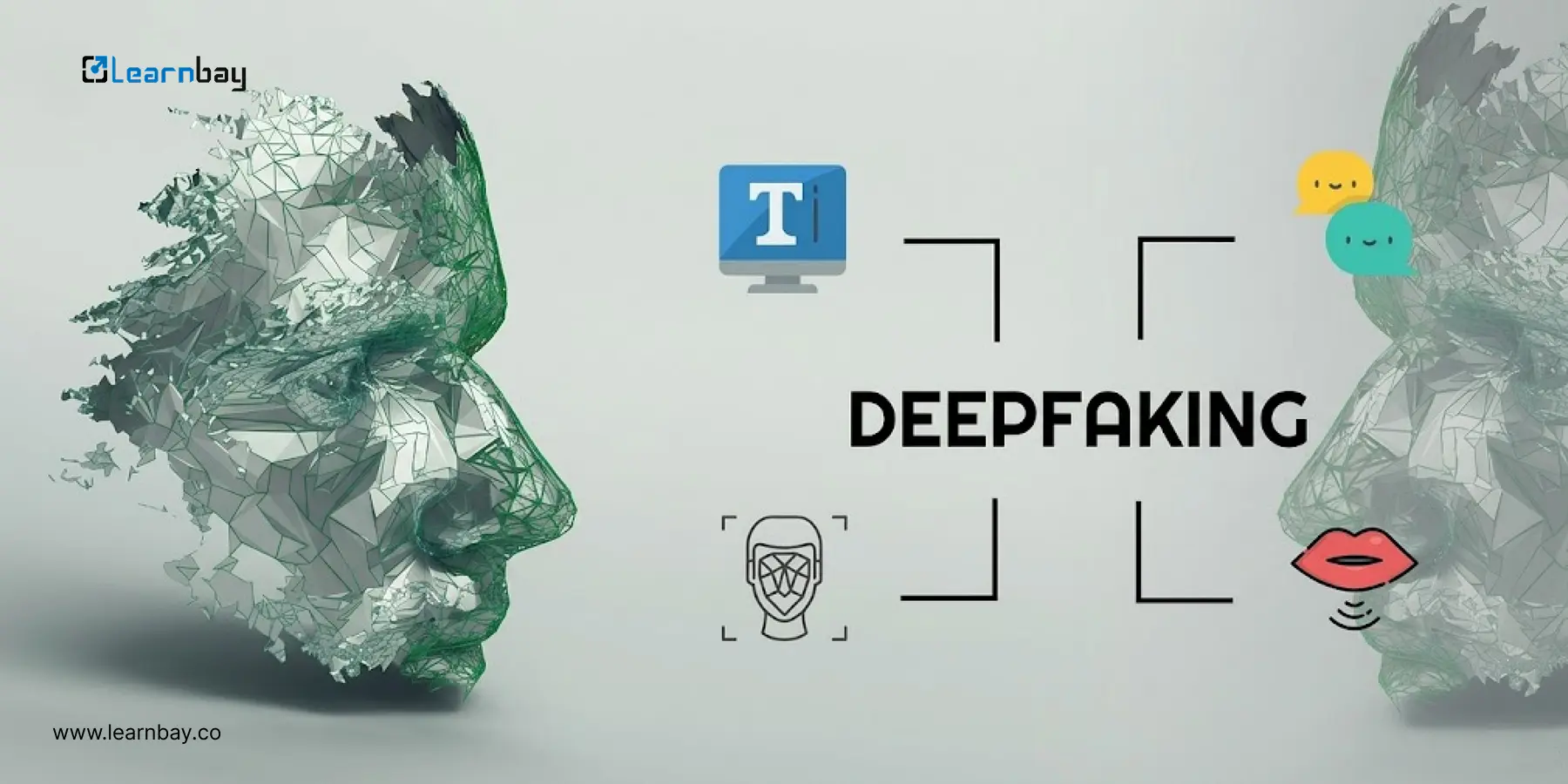
• Text Generation
Text Generation is a method of autonomously generating text, writing stories, prose, and poetry, constructing abstracts of long documents, and synthesizing using AI approaches for text and deep learning.
Text generation is the process of using computers to produce human-readable text, often in natural language, for website content. The generated content can be in the form of whole sentences or phrases, used to fill in the blanks with individual words, or reviewed by a human before publication.
• Speech cloning
Artificial Intelligence is still in its nascent stages, but it is making significant strides every passing day. Speech cloning is a deep-learning technique that uses an individual's voice recordings to create a synthetic voice that sounds identical to the original.
Speech cloning is a method of creating a personalized voice font for a person and then using that font to make a speech.
• Lip-syncing
The method of synchronizing a character's lips to a taped voice soundtrack is known as lip-syncing. Dubbing is the inverse of this technology, in which a character's mouth movements are matched to a prepared voice track.
Lip-syncing technology uses AI algorithms to fake original characters and digitally manipulate social media posts. It undergoes an audio synthesis process that syncs with the original voice track.
• Face-swapping
Face-swapping has become a popular convention on practically every social media platform. Users of social media platforms such as Snapchat can send photos to their friends and others, substituting their faces with a different image or even a cartoon.
Facebook users can use filters to replace their acquaintances' faces with their own on social media sites. Face-swapping has become a popular fad on social networking platforms. It is becoming increasingly lifelike as technology advances.
So these were the few applications where Deepfake and synthetic AI were used, and with such characteristics, there has been a sequential growth in both beneficial and negative uses of the application.
Moving forward, the application's few merits and demerits are:-
Merits of Deepfake and Synthetic data:-
• In today's increasingly digitized and virtual world, it's becoming easier to replicate something that was once a tangible object as an artificial intelligence-driven medium. The main domain where the technology is focused is audio and video. There is an ever-growing list of AI-generated media that can be customized to meet your demands.
• Synthetic Media will democratize content creation by making large-scale music, video, and image production easier and more cost-effective, without the need for expensive physical processes.
• It undergoes video synthesis that creates detailed avatars of individuals from which realistic videos can be created. It's the ability to create a self-expression avatar experience. It's a fantastic trend that helps people broaden their goals, ideas, and convictions.
• Actors play a crucial role in any film. Their job is to provide realism to the film. But what if you could make the movie feel more realistic by reducing the time the actors spend on set? Artificial intelligence and Deepfake AI accomplish this. Filmmakers would be able to focus more on the film's overall quality if the performers' time were freed up, allowing them more time for editing, etc.
Demerits of Deepfake and Synthetic data:-
• Artificial intelligence (AI) is clearly headed toward becoming a more visible aspect of our media consumption. Companies are progressively incorporating AI into their designs for media personalization. It makes their online content more intelligent and comprehensive, but the primary concern is when the usage of AI makes some types of synthetic media risk for brands to incorporate.
• Deep fakes are a cutting-edge technique for video synthesis and audio synthesis in a completely undetectable way to the observer. Deep fakes have the potential to change the way we transmit information since they are a low-cost, high-impact technique to skew the truth.
• AI-generated media frequently lacks in various fields of arts and crafts, and they don't appear to produce clear and useful output.
How is synthetic media used in business communication?
If you've heard about all of the numerous varieties of virtual reality, you might be perplexed by this field of technology. AI in entertainment, media,or service sectors relies on these creations for seamless operations. Its association with other concepts like augmented reality and mixed reality brings a powerful change.
Content creation automation has become a powerful tool for several businesses. It empowers experts to create engaging content and reach maximum audiences. However, the rise of deepfake technologies challenges its interaction ways.
The way we communicate will alter as a result of synthetic media. It will alter the way we interact as well as the way we think. Artificial intelligence-driven text synthesis is the most obvious example of synthetic media.
Final thoughts
We hope you enjoyed our Generative AI blog! This is a relatively new technology industry, and we certainly look forward to seeing how it develops and benefits businesses and customers in the next few years.
With every significant breakthrough, both the benefits and drawbacks of the product increase, but we can also conclude that the application cases of generative AI and synthetic data are numerous, and it has most likely changed the AI and marketing industries immensely.
AI in modern businesses reshapes core operations, driving sustainable gains. AI in marketing, healthcare, media, etc, sectors brings notable changes to job market dynamics as well. Hence, constant learning of GenAI trends is essential. You can enroll in the Generative AI and Agentic AI Certification for Working Professionals program.
FAQs:
What is Generative AI technology?
Ans. Generative AI is an advanced AI innovation that empowers businesses to create realistic and captivating content. It uses vast datasets and user prompts to generate texts, images, audio, and video content.
Will Generative AI replace working professionals?
Ans. No. Generative AI cannot completely replace human experts. However, experts with generic skills can lose their jobs due to GenAI advancements. Hence, constant learning of GenAI tools and trends is vital to staying ahead in the career race.
What techniques are used in deepfakes?
Ans. Deepfake technology mainly uses machine learning and deep learning algorithms. Also, experts use artificial neural networks and advanced Gen AI algorithms to fake original texts, voice, and social media content.