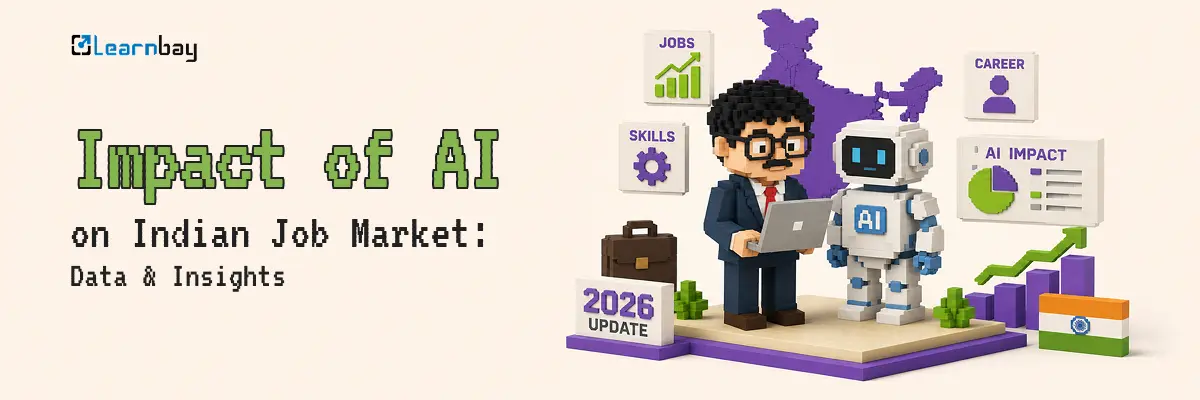
Insights Into the Impact of AI on India's Job Market: Is Your Career Ready?
As of mid-2026, AI has not caused massive job losses for many. According to Forbes India reports, unemployment after the AI evolution still sits at 3.1% in the country. On the other hand, AI itself has created impressive career opportunities with over 290,000 new job postings in 2025. However, the impact of AI on IT jobs in India shows a decline in hiring, with FY24 recording only 60,000+ job postings. In short, AI is redefining the workforce and associated operations instead of completely replacing them. Now, in 2026, it's not “AI vs. human”; it's actually “AI vs. professionals who cannot direct AI”.
In 2026, every IT professional, analyst, marketer, or content creator is asking one question – “Will AI replace my job?”
A quick answer is no.
According to reports, over 45.2% of India’s AI usage goes to IT development operations and engineering tasks compared to other uses. However, many professionals are failing to secure their jobs or make relevant decisions due to AI-specific headlines.
This blog will break down the facts on jobs, skills, and career paths that every working professional should know in 2026.
The Bigger Picture: AI Hasn’t Replaced India’s Tech Jobs – Yet
As of now, there is no AI-driven unemployment crisis in India’s database. The country’s economy is not discarding IT professionals; instead, AI is redefining those roles and introducing more specialized career paths.
To understand the actual situation, let’s have a look at industry facts.
| Metric | Figure | What it tells you |
|---|---|---|
| Software share of AI use | 45.2% | According to the Anthropic Economic Index Report 2026 , India's AI usage is the most software-concentrated in the world. |
| Net new tech jobs (FY24) | +60,000 | This has reduced from +445,000 in FY22, despite rising revenue. |
| Workforce in AI-exposed IT roles | ~1% | A small but educated, urban, higher-paid slice of ~600M workers. |
| AI-focused hiring growth in India | +59.5% | AI is creating demand, not only displacing it, as India's AI job boom is getting real in 2026. |
Exclusive tip for IT professionals: If you are involved with AI-exposed work in your company, mastering essential Generative AI skills and agentic models is crucial in 2026.
The industry data does not state that tech jobs are dead or that AI is replacing them; instead, it emphasizes AI literacy rather than competing with it.
Impact of AI on the Job Market of India – Sector-Wise Analysis
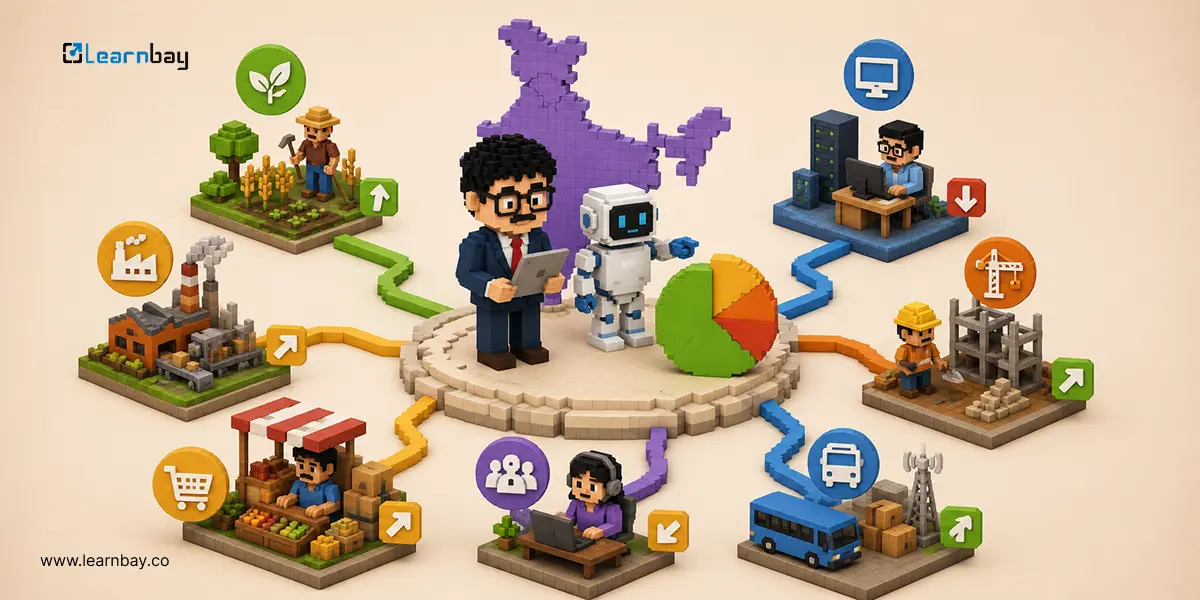
Even in 2026, there are major tasks in India that human experts do better than large language models (LLMs). Over 43% of the Indian workforce is still involved in agriculture, trade, construction, and manufacturing sectors where chatbots or AI agents cannot generate wins.
AI adoption in India is creating history and bringing productive results to some industries, not for all.
The AI-exposed IT and ITeS workforce is about 5.8 million people, roughly 1% of India’s ~600 million-strong labour force. In short, only 16% of India’s total IT workforce is AI-skilled as of 2026, as stated by NASSCOM.
So, the real fact is that if you’re a tech professional, you may be at risk due to AI, while the rest of the sectors are still safe.
If we compare PwC, Anthropic, and NASSCOM reports, over 62% of large-scale Indian firms use GenAI tools to accomplish their tasks. But skills gaps are there.
Following this, medium-scale enterprises are catching up with AI faster than others, with just a 2.4% skill gap. However, small-scale enterprises are showing potential knowledge gaps in AI.
Coming to the sector-wise analysis, the AI impact on Indian IT jobs is at a higher risk compared to other sectors.
| Sector | Share of employment (2025) | AI exposure |
|---|---|---|
| Agriculture | 43% | Low |
| Manufacturing | 13% | Low–Moderate |
| Trade & hotels | 13% | Low–Moderate |
| Other services | 13% | Mixed |
| Construction | 12% | Low |
| Transport & comms | 6% | Low |
| IT / ITeS (AI-exposed) | Approx 1% (5.8M) | High |
Note: This 1% share of employment exposed to AI dominance is at greater career risk. Hence, such professionals should gain AI literacy, master Agentic AI frameworks, and work with real agents to succeed in the AI age.
The Impact of the AI Paradox: Rising AI Hiring vs. Rising Tech Layoffs
This is the context that is actually buzzing across India. AI adoption in India has cut the workforce into two segments – one that sees growing hiring trends and the other that is facing massive layoffs.
The Tech Layoff Side
- NDTV's labour report states India’s 2nd worst hit comes with the tech layoffs in the 1st half of 2026 accounting for roughly 7.16% of the 1.28 lakh global tech jobs.
- NITI Aayog’s roadmap for job creation in the AI economy 2025 report reflects a worst-case scenario where the tech workforce may be reduced to 6 million by 2031 due to AI dominance.
- As AI takes supremacy over IT companies in India, more than 35K jobs are at risk of layoffs in the upcoming months of 2026, as stated by an ET Prime report.
- AI dominance is seen across the fintech, software, and automobile sectors as work automation takes place in 2026. – India Today 2026. AI is automating tax, financial tasks, coding, and automobile operations without human intervention.
Indeed, tech layoffs are getting severe, affecting the economic and psychological well-being of professionals. Hence, upskilling has become crucial to survive tech layoffs and the AI’s impact on employment. Professionals can develop 4 essential skills that Big tech firms cannot replace in 2026.
The Rising Hiring Trend
- NASSCOM's Strategic Review 2026 estimates the Indian tech industry added a net 1.35 lakh jobs in FY2026. This reflects an aggressive hiring trend to optimize work productivity in the long run.
- AI-led hiring rates are increasing, as Naukri reports over 82,000 AI job postings in July 2026.
- PIB reports on AI hiring specifications state that 6 million professionals have already been hired in the tech and AI ecosystem, and it is expected to increase India’s economy by $1.7 trillion in revenue by 2035 through AI-driven operations.
- Industry reports state that over 89% of total startups in India have already adopted AI for core operations.
However, AI literacy in India is still a concern for many professionals and career roles. Various big firms in India report that Generative AI adoption across functional teams has increased their productivity gains.
Skills matter more than educational degrees, as around 73% of employers demand to hire AI-skilled experts rather than generic ones.
Indeed, AI layoffs are increasing, and AI hiring is simultaneously pacing up in India. And the main reason is that many companies are aggressively restructuring their workforce for AI readiness. Professionals in routine roles and resistant to AI literacy are losing their jobs to highly-skilled AI experts who can build, manage, and deploy AI models.
Who is More Exposed to AI in India?
The clear and concise answer to this query is: IT professionals.
The fact does not indicate a growing unemployment trend in India; instead, it shows that professionals are not getting hired for trending roles. IT professionals in Bangalore, Hyderabad, Pune, and Delhi are highly exposed to AI-related roles.
According to reports, over 75% of tasks are already exposed to LLMs. This shows AI’s supremacy over crucial IT tasks that may affect regular jobs.
In a workforce where only 4.2% of people have any formal vocational or technical training, this is precisely the slice with the most to gain from AI fluency and the most to lose from standing still.
Which Jobs and Tasks are Exposed to AI in India?
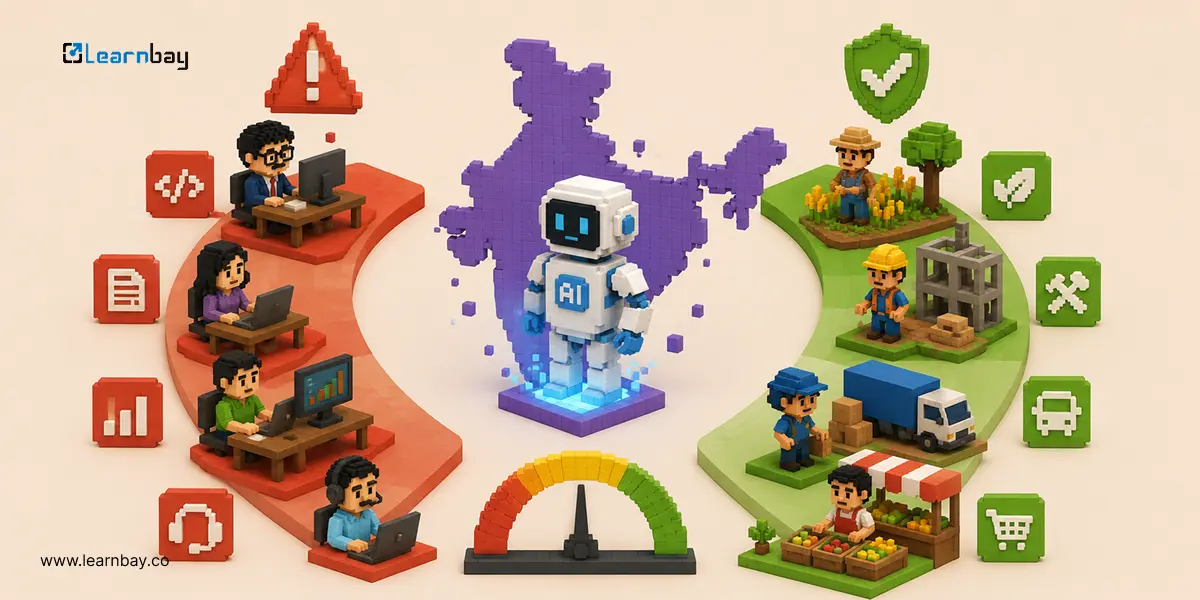
AI’s impact on career roles and job tasks classifies them into two categories: high exposure and low exposure.
High-exposed AI roles and tasks do not mean replacing jobs. It implies that the majority of tasks are now AI-driven. Hence, such roles demand constant upskilling through the best GenAI and Agentic AI courses in India to stay competitive.
On the other hand, low-exposed roles are basically the traditional ones that still require human judgment and intervention to accomplish tasks.
Let’s consider the facts to review AI's impact on employment in India.
| Categories to consider | Examples | Industry outlook |
|---|---|---|
| High AI exposure, declining hiring | Software Developers, manual QA testers, routine documentation, customer support professionals | Shrinking, being absorbed by AI tools and senior staff using AI |
| AI-Native roles | Senior AI architects, systems designers, AI/ML engineers, AI governance, prompt engineering, LLMOps, and MLOps | Strong demand: these roles increasingly direct AI rather than compete with it |
| Low AI exposure, growing demand | Cybersecurity professionals, healthcare professionals, tradespeople, firefighters | Fastest-growing hiring category in 2026 |
| Client-facing / judgment-heavy | Solution consulting, account management, advisory roles | Expected to grow as enterprises seek AI adoption guidance |
Further supporting this, Anthropic data reflects the high AI-exposed roles, such as IT developers, customer service representatives, data-entry experts, and programmers across the industry.
On the contrary, marketing, content, BFSI, and investment professionals are at moderate risk levels.
To be precise, AI cannot replace every role or accomplish every task. The career roles and responsibilities that require human instincts, good judgment, client trust, novelty, system design, and accountability will always need humans.
The Other Side of the Story: Will AI Replace Your Job?
AI replacing your job is real – but not the complete story.
Professionals in the tech sector fear AI dominance as it has started doing core technical tasks, such as coding, debugging, etc. However, you must note that work augmentation has now taken over work automation.
That means AI agents are now assisting human experts rather than automating their daily tasks. Hence, professionals with proven AI knowledge can work collaboratively with such agents and models.
According to the PwC Global Job Report 2026, AI is introducing a two-track labor market where professionals should have both AI technical skills and leadership traits to tackle intricacies.
Following a Generative AI learning roadmap can help tech professionals gain essential skills and work collaboratively with AI models for various tasks.
In short, professionals who are ready to upgrade their skills in real time and use AI to enhance their productivity will stay competitive.
In addition, some new roles are coming in 2026, such as AI/ML engineers, AI platform builders, AI product managers, and AI governance specialists. According to the IMF Skills Report 2026, professionals should have at least one specific AI skill to land promising roles in India and overseas.
The World Economic Forum reflects on four typical scenarios that are expected to redefine AI and talent strategies by 2030.
- Supercharged progress: AI evolution and dominance in the past few years have made groundbreaking progress, but governance and social safety remain concerns.
- AI displacement: It encourages professionals to develop AI-driven skills to stay competitive and secure their jobs, as AI may displace a few major tasks.
- Co-Pilot: AI progress and readiness gradually shift focus toward AI augmentation (52%), reshaping business models.
- Stalled progress: Despite AI readiness, talent gaps are widely seen across sectors that need to be addressed.
One short tip: Gain AI literacy to survive AI dominance in 2026 and beyond.
Job Evolution in the Age of AI
This table shows how AI has revamped traditional roles to accelerate productivity and success.
| Traditional Role | AI-Powered Role | Impact of AI |
|---|---|---|
| Software Engineer | AI Engineer / AI Application Engineer | Builds AI-powered applications, integrates LLMs and AI agents, automates coding with AI copilots, and focuses more on system design than repetitive coding. |
| Data Analyst | AI Data Analyst | Uses AI to automate data cleaning, visualization, and report generation while focusing on business insights and decision-making. |
| Data Scientist | AI & GenAI Data Scientist | Moves beyond predictive models to developing LLM applications, RAG pipelines, multimodal AI systems, and AI agents. |
| Machine Learning Engineer | Agentic AI Engineer | Designs autonomous AI systems, orchestrates AI agents, and manages memory, reasoning, and tool integration. |
| Business Analyst | AI Business Analyst | Uses AI for extensive market analysis, forecasting, requirement generation, and process optimization, enabling faster strategic decisions. |
| Project Manager | AI Project Manager | Uses AI for project planning, risk prediction, resource allocation, documentation, and automated status reporting. |
| DevOps Engineer | AI DevOps Engineer (AIOps) | Uses AI to automate infrastructure monitoring, incident detection, root-cause analysis, and deployment optimization. |
| QA/Test Engineer | AI Test Engineer | Generates test cases automatically, predicts software defects, automates regression testing, and improves software quality with AI. |
| Cybersecurity Analyst | AI Security Analyst | Applies AI for threat detection, anomaly detection, malware analysis, and automated incident response. |
| Cloud Engineer | AI Cloud Engineer | Deploys and manages AI infrastructure, optimizes GPU workloads, and automates cloud operations using AI. |
| Database Administrator | AI Data Platform Engineer | Uses AI for database tuning, query optimization, predictive maintenance, and intelligent data governance. |
| UI/UX Designer | AI Experience Designer | Uses GenAI to create prototypes, design assets, personalize interfaces, and accelerate user research. |
| Digital Marketer | AI Marketing Strategist | Uses AI for content creation, campaign optimization, customer segmentation, and predictive marketing analytics. |
| HR Recruiter | AI Talent Acquisition Specialist | Uses AI for sourcing profiles, resume screening, interview scheduling, workforce analytics, and skills assessment. |
| Customer Support Executive | AI Customer Success Specialist | Monitors AI chatbots, resolves complex customer issues, analyzes customer sentiment, and improves AI-driven support services. |
What does this mean for Indian Professionals?
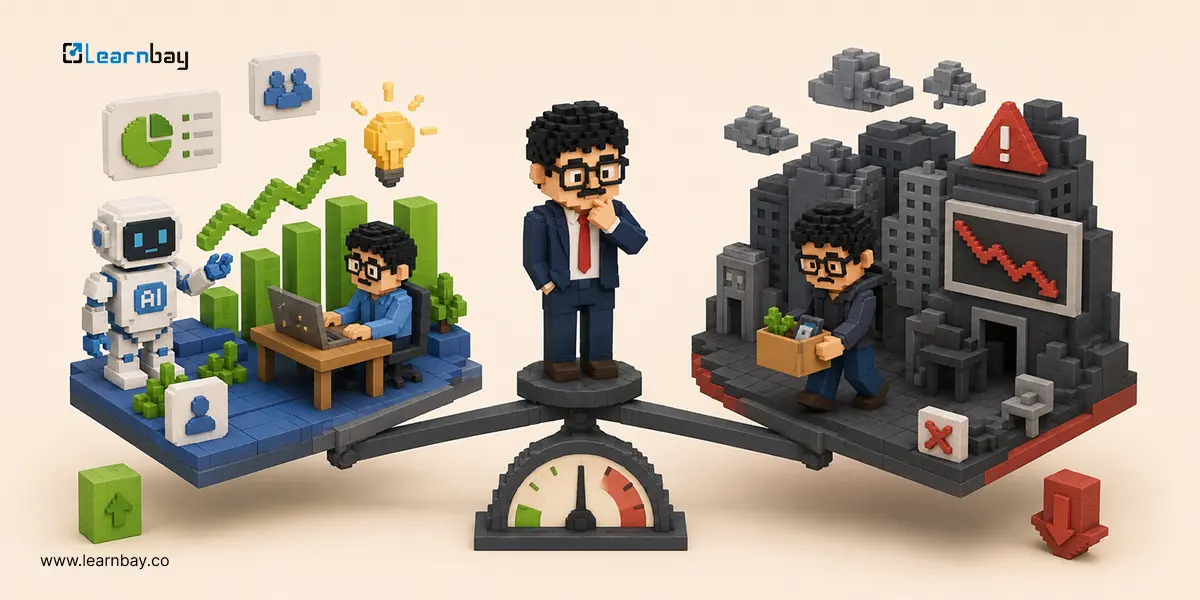
The data points to a clear conclusion: AI isn't eliminating India's tech workforce; it's redefining & re-sorting it.
Professionals involved in easily-automatable tasks with no supportive AI skills are at higher risk. The professionals who've moved beyond "AI-aware" to "AI-skilled" are seeing strong industry demand. They are now comfortable working with machine learning, GenAI tooling, data pipelines, and increasingly, agentic AI frameworks.
For working professionals and career-switchers watching this shift unfold, 3 things stand out amid AI’s impact on the job market:
- Entry-level roles are highly AI-exposed — traditional fresher hiring in IT/BPO is being revamped, so entry-level professionals face the most pressure to differentiate their skills in applied AI and data rather than routine technical skills.
- The AI skills gap is unavoidable — with only an estimated 16% of India's IT workforce currently AI-skilled against demand. Hence, structured upskilling has a measurable payoff against AI dominance.
- Judgment-based and specialist roles are the safest — ML engineering, applied data science, AI governance, and domain-expert consulting roles are growing even as routine coding roles shrink.
Then, who should worry?
- Freshers or entry-level professionals: AI agents are handling essential tasks on behalf of human experts. Hence, freshers with little or no real-time AI knowledge can be at risk.
- Professionals with 2–5 years of experience resistant to AI upskilling: Experts who do not use AI tools and are not willing to gain AI literacy may get replaced sooner.
- Senior engineers: Such IT professionals are at risk due to AI-generated code. If they fail to upgrade their skills on time, AI may replace them.
- Managers: Senior managers with routine tasks, documentation, coordination, and status update responsibilities are at high risk.
No wonder career upskilling is the only solution to survive AI-driven layoffs or industry restructuring.
Professionals who constantly master in-demand tools, gain AI literacy, work on agentic AI projects, and earn certifications can thrive. It empowers professionals to stay ahead of AI developments and shift themselves from the “at-risk” to the “in-demand” range.
What the next 3 – 5 years are likely to look like with consideration to AI’s impact?
In the upcoming 3 – 5 years, AI will take over everything that will remain incapable of handling, building, and deploying AI models. By 2030, most likely agentic models will autonomously perform crucial tasks, replacing the underskilled professionals.
In the next 3–5 years, you will see –
- Agentic AI will run multi-step tasks without human intervention.
- More use of physical AI, such as smart robots, drones, and autonomous systems.
- Evolution of hyper-realistic media
- AI as an active lab assistant making groundbreaking success in medical science.
The Bottom Line
The labor market impact of AI in India speaks to a fact that many professionals are missing in 2026. It's not a tale of job displacement or employment; instead, it’s how AI is redefining tech tasks.
AI developments and expansive presence across the Indian IT sector state the essence of upskilling. Tech layoffs are real and will continue for those who stay under-skilled in the AI age. Hence, the best AI course in India are designed to help such professionals build specialized skills and remain irreplaceable in 2026.
If you’re someone who is highly engaged with routine tasks, coding, or documentation-like roles, it’s a good time to build real-time AI skills. Enrolling in the GenAI and Agentic AI Master’s Program with working on AI projects can help you build, manage, and deploy AI models.
FAQs:
What percentage of India's AI usage is tied to software work?
According to Anthropic's survey report, 45.2% of India's AI usage is tied to software development and related occupations, the highest share of any country globally.
Is AI causing job losses in India's IT sector?
AI-linked layoffs are real and mostly focus on entry-level roles. India recorded the second-highest share of global AI-related tech layoffs in the 1st half of 2026. However, NITI Aayog and NASSCOM data show the sector is still adding new AI-driven jobs overall, with hiring shifting toward AI-specific skills rather than shrinking entirely.
Is there a shortage of AI talent in India?
Yes. NASSCOM and Deloitte estimate India's AI talent pool was around 4.2 lakh professionals in 2024 against demand already exceeding 6 lakh, roughly a 50% talent gap. NITI Aayog projects the shortage could reach 14 lakh professionals by the end of 2026 if the upskilling rate reduces.