Know The Trending Data Science Tools That Every Data Scientist Should Learn
We are witnessing amazing advancements in the technological field these days. AI chatbots to produce meaningful conversations like humans, machines that can automate daily tasks to increase efficiency, and more technologies are creating global waves. These innovations are possible because of some highly effective data science tools.
Automating tasks and other artificial intelligence-related innovations require an extensive degree of complex coding, real-time data analysis, and data visualization. The proper execution of such tasks is not that easy. But a bunch of tools used in data science have made the process really smooth.
We can apply different tools in varying steps. However, understanding these tools and their usage is needed to work on a data science project effectively.
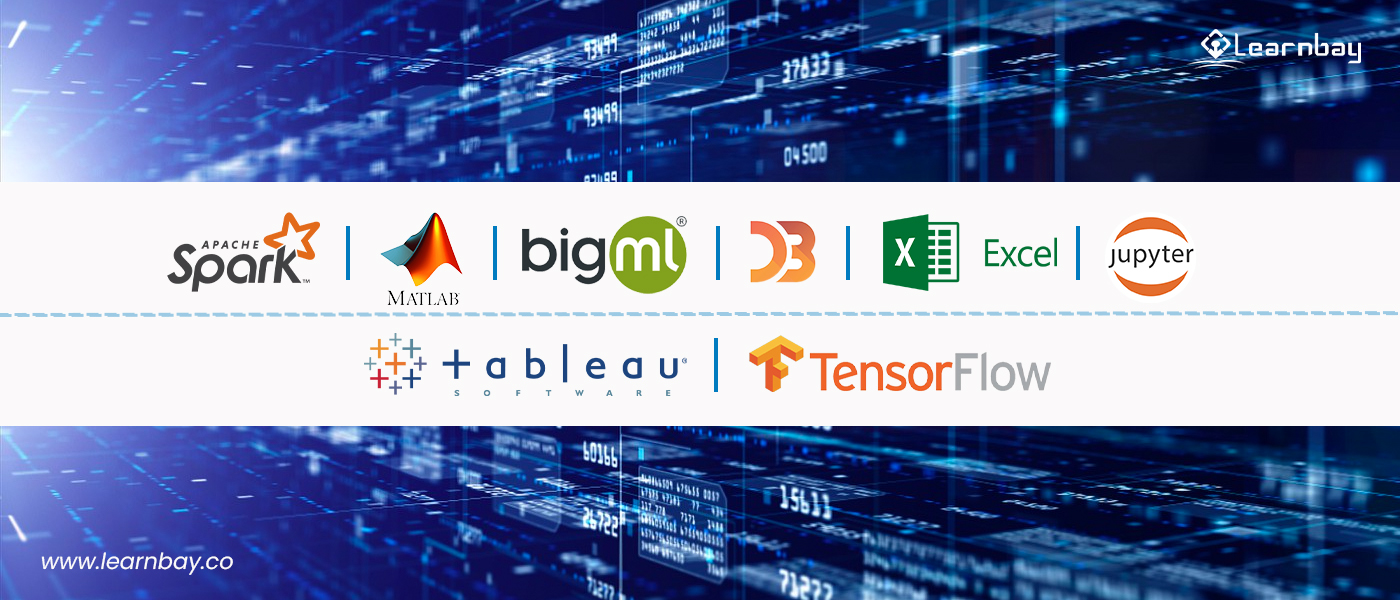
The most used data science tool list of 2026
1. Apache Spark:-
Apache Spark can handle batch and process streams like other data analytics tools (Hadoop). It is among the best tools for data science, capable of handling large data volumes.
It can access real-time information from data sources, which is a huge improvement over other trending data science tools that can only handle historical data.
Spark processes data using the cluster management system. The system allows it to process applications at lightning speed. Due to its varied built-in machine learning APIs, it is also used as a machine learning tool.
Features:-
- This is one of the most used tools for data science and a well-known library/framework in data science.
- Different APIs can be programmed in Python, Scala, Java, and R. Scala is the most popularly used language as it's cross-platform and based on JVM (Java Virtual Machine).
- Various machine learning APIs are present that help make powerful predictions.
- Data scientists can make multiple accesses to data, helping them create a quicker model.
2. MATLAB:-
It is a high-performance mathematical and data-driven decision-making data science tool. It can perform matrix functions, statistical modeling, and algorithmic analysis. But the tool is a closed source.
MATLAB is a versatile tool available for managing all data-related problems, from data analysis to data visualization. It is also used in complex deep-learning algorithms. It makes it easy to use for embedded systems and enterprise applications.
Features:-
- MATLAB can simulate fuzzy logic and neural networks.
- It can be utilized for signal and image data processing due to its ability to create powerful visualizations.
- It has an easy-to-use ecosystem that helps test various data models.

3. BigML:-
Another one of the widely used tools in data science also aids in machine learning operations. It is an easy-to-use cloud-based GUI (Graphics User Interface).
BigML helps companies use machine learning algorithms for risk analysis, weather forecasting, threat analysis, and more. Various ML algorithms, such as classification, clustering, time series, etc., provide their software with a wide range of applications. However, it's specifically used in predictive modeling.
Features:-
- A user-friendly web interface created using REST APIs.
- BigML can generate interactive data visualizations.
- Companies use it for various data science and ML business operations.
- It comes with automated systems eliminating the need for manual data workflows.
4. Tableau:-
Tableau ranks among the most prevalent enterprise data visualization tools by top MNCs. It also has a data analysis tool for performing analytical operations. It is one of the simplified data visualization tools with different options.
Complex and advanced visualizations and analytical operations are done in less time using Tableau. This makes the tool a must-have for companies in their business operations.
Around 60,000 companies use this tool to create interactive dashboards and help businesses make strategic decisions.
Features:-
- It can create interactive dashboards and interfaces using its powerful graphics.
- It can interface with spreadsheets, OLAP (Online Analytical Processing) cubes, databases, etc.
- You can visualize graphical data and plot longitudes/latitudes in maps.
5. TensorFlow:-
TensorFlow is one of the best tools in data science and has wider applications.Recent uses include NLP for creating machines capable of understanding human language, handwriting recognition, image classification, and recurrent neural networks.
Data scientists can use this tool in drug discovery, speech recognition, image and language generation, and more applications. It got the name ''Tensor'' from the data type used in this tool which is an N-dimensional array.
Features:-
- This tool makes it easier to deploy data science models on different devices and applications.
- TensorFlow can handle advanced numerical calculations and supervised,
- Its main features are machine learning and deep learning libraries. It offers high performance and computational power, which helps the tool run on CPUs, GPUs, and even powerful TPU platforms.
6. Excel:-
It is a traditional data scientist tool used for analysis. It is one of the most impressive data visualization tools that can create strong visualizations on command. It is combined with SQL to manipulate and analyze data. Different types of visualization tools are available such as graphs and charts. It is simple enough to represent data in rows and columns.
Excel is easily understandable, and even non-tech professionals can learn how to use it. It is suitable for rapidly grasping data. It has built-in formulae, filters, tables, and more that make the tool very useful. You may even create your own functions and formulae using Excel.
Excel ToolPak is the add-in feature of this tool that is specially designed to tackle complex data analysis. Experts can apply various statistical functions to analyze datasets efficiently.
Features:-
- Data scientists utilize Excel for data cleaning. They can pre-process the data using its interactive cloud-based GUI environment.
- Excel ToolPak is a newer version used for complex data analysis.

7. Jupyter
Jupyter is an open-source tool to help software engineers create open-source software. It provides interactive computing and is mainly used for Python coding. It also supports languages like R, Julia, and Fortran.
This is one of the most interactive open-source notebooks, useful for web designing. You can do live coding, perform visualizations, and create presentations to share online with your network of peers.
Features:-
- Use Jupyter notebooks to perform data visualization, cleaning, and statistics. You may create predictive machine learning models as well.
- It accepts over 40 programming languages.
- You can easily connect Jupyter with other data analytics tools to perform better.
8. D3.js
It is a Javascript library that you can use to make interactive data visualizations and data analysis on your web browser. This data scientist tool helps utilize web browsers to their full capability. There are various APIs present to automate the process.
An impressive feature in D3.js is its usage of dynamic updating, through which any modification in the document from the client side is automatically reflected in the visualizations.
Features:-
- Integrating it with CSS can help make illustrative visualizations.
- It is helpful in IoT-based applications by providing a client-side interface for data processing.
Why do businesses need data science tools and technologies?
- Data science tools help in performing efficient data science practices. They help collect, manipulate, and evaluate business data, which will help derive essential insights.
- Data can be monitored in real-time through the trending data science tools. This is a time-saving effort that helps businesses run efficiently. It provides flexibility in monitoring the data and making quick decisions.
- By combining data from different sources and applying algorithms and predictive modeling to the data, business operations can be optimized for faster results using data science tools.
Data is an essential part of every business's success, and data science is the medium. Without proper knowledge of data science or data analytics tools, however, one cannot utilize data science effectively. Therefore, any data scientist needs to hold adequate knowledge of the trending data science tools being used primarily in industries. This aids in your understanding of the field as well as helps you land a data science job.
Conclusion
Online data science is ideal for learning these essential tools, mainly in the AI-driven age. Such courses will provide full-scale knowledge of these data science tools with updated modules for better understanding. You can enroll in a course and get an overview of the usage of such tools in different fields.
If you think data science is your field of interest, then the Advanced Data Science and Generative AI Program will be an excellent choice for you. You learn from the industry experts with years of experience in data science and Gen AI. This brings the perfect opportunity for your career growth in data science.
FAQs:
Is data science in demand in 2026 and the upcoming years?
Ans. Data science is an ever-evolving field with constant demand for skilled professionals. Its seamless integration with different industries shows an upward hiring trend. However, data science is evolving and reshaping its dynamics in 2026, inspiring professionals to upskill. Hence, professionals with the right knowledge of data science tools and trends can succeed in 2026 and afterwards.
Which is the best data science skill you must have?
Ans. Python is the most widely searched data science skill that every professional must have. Its flexible and scalable features make it user-friendly. Hence, professionals willing to kick-start a promising data science career must learn Python.
Is data science a challenging job?
Ans. Yes. Data science can be a challenging job due to its ever-evolving dynamics within the industry. However, professionals with constant learning and the right knowledge of the trending data science tools can stay competitive.