.webp)
Looking for the best AI course in India in 2026? After exploring over 50 AI courses in India and comparing their fees, course details, certifications, and placement support, I've put together a list of the 9 courses that stand out the most. This guide shares what each Data Science and AI course in India offers, including pricing and who it's best suited for.
Here's a quick summary of what I discovered.
From more than 50 AI and GenAI programs I explored, these are the 9 best courses for learners in 2026 that truly caught my attention. Learnbay’s GenAI & Agentic AI Master Program, a fully live, domain-specific course, is ideal for working professionals seeking their AI-first role. For admission to an IIT, the E&ICT Academy at IIT Roorkee is recommended. For formal qualifications, upGrad offers an MS in partnership with LJMU and IIIT-B. For an initial interest check, Coursera or PW Skills are effective options. GUVI provides weekend classes for learners who prefer studying in a vernacular Indian language.
To be precise, none of the courses listed here will guarantee you a job. Anything that claims or promises is worth questioning.
Pick your scenario
| If this sounds like you | Start here | Why |
|---|---|---|
| 1–15 years in a non-AI career, want to switch without restarting | Learnbay GenAI & Agentic AI (IBM & Microsoft) | Role-based tracks, live cohorts, domain-mapped capstones |
| Non-technical, don’t want to learn to code | Applied AI Practitioner (IIT Patna) | No-code/low-code, IIT Patna (Vishlesan i-Hub) + IBM certified |
| I want an accredited master’s degree that travels internationally | upGrad (LJMU) or Learnbay MS (Woolf) | ECTS/WES-accredited, recognised for visa and credential evaluation |
| I want an IIT name on my CV | IIT Roorkee (E&ICT) | 6 months, online, IIT-issued certificate |
| I want structure but not a full degree | Simplilearn (IIT Kanpur) | 11 months, live, 15+ projects |
| I want a global university brand, no coding background | Great Learning (UT Austin) | 12 months, built for non-programmers |
| I learn by building, not by watching | Udacity Nanodegree | Project reviews and mentor feedback |
| English is a barrier, weekends are my only free time | GUVI Zen Class | Indian local languages, Sat–Sun live |
| I have ₹10,000 and want to test my interest | PW Skills (Basic plan) / Coursera | Low commitment, low risk |
Why I bothered writing this
I recall sitting with a course brochure at 11 pm, feeling truly puzzled about why an “AI course” would take six weeks just to teach Python. My social media feed was buzzing with ₹9 workshops claiming I’d become an “AI expert by Sunday.” Everyone seemed eager to share their opinions, but few had any real proof.
The breakthrough came during a chat with a colleague who, as a B.Com graduate and AI team lead at a manufacturing firm, initially offered no institute suggestions when asked. Instead, he described a project in which he developed an ML model that predicted and flagged supply chain delays before they affected production. He explained the model's failure cases, showed me the three versions he built, and finally presented his final model, which earned him his promotion.
That was my moment of realization: he wasn't hired just for the certification, but for the incredible value he could demonstrate.
Over the years, I've observed many colleagues face this challenge. Success has rarely come to those who choose the most costly, prestigious programs. Instead, it has come to those who choose programs suited to their current level. Conversely, those who were unsuccessful often chose programs meant for a very different level.
Each of the courses on this page is evaluated on one question. What can you demonstrate in an interview after completing the course, and who is the course specifically designed for?
Why the 2026 decision is different from 2025
I spent several weeks examining the hiring data from India prior to reviewing any course syllabi. Four new insights altered my ranking of the programs.
The gap is real and is not closing. According to a report by Deloitte and NASSCOM, Indian AI talent is projected to grow from approximately 600–650k to more than 1.25 million between 2022 and 2027. Given the scope of an AI market that grows 25–35% per year, the gap is expected to widen.
According to Bain & Company, the talent supply is estimated at 1.2 million, whereas the demand is approximately twice that figure. By the year 2027, the number of executive AI-related job openings in India may exceed 2.3 million, with 44% of executives asserting that insufficient in-house AI skills constitute a primary obstacle to the deployment of generative AI.
AI-related job roles continue to command a pay premium. According to PwC’s Global AI Jobs Barometer 2026, AI skills offer a pay premium of 62%, up 5% from the previous year. Additionally, AI-related roles have grown by 69%, outpacing the 9% rise in total job roles.
The pay landscape is also evolving. According to NITI Aayog’s Roadmap for Job Creation in the AI Economy (October 2025), developed with NASSCOM and BCG, IT Services employment in India, currently between 7.5 and 8 million in 2023, is projected to decline to around 6 million by 2031. Meanwhile, AI-related jobs could see an increase of up to 4 million. The report estimates that AI talent demand is currently about 50% of the existing total.
Roles are emerging, the pay is genuine, and there's a shortage of qualified people to fill these positions. This gap represents an opportunity. However, having a certificate alone won't bridge this gap.
In 2026, the demand for applied AI professionals is rapidly increasing, setting new hiring standards. Now, employers need such professionals who can build and deploy an AI agent, rather than having limited theoretical exposure. This the employment market can be seen as having two main parts: one focused on theoretical knowledge and the other on practical skills. AI exposure. Yet, many upskilling programs have not adapted to the new developments. Hence, evaluating the course syllabus is the most proactive step that every learner should take.
How this ranking was created
I reviewed over 50 AI/GenAI programs. I compared them based on fee structures, course syllabi, testimonials across multiple digital platforms, and third-party salary data from various online portals and databases.
The rank order relied on five key elements.
-
Who the program is designed for - freshers, working professionals, non-technical switchers, or someone seeking a formal educational credential. Most mismatches and resulting disappointment can be directly traced to an incorrect answer to this key question.
-
Live vs. self-paced , and how genuinely 2026-relevant GenAI, agentic AI, and deep learning content fill the syllabus. A “GenAI course” that is largely all prompt engineering is an older course with a 2026 label.
-
Project depth - reviewed , domain-specific work vs. generic case studies utilizing pre-cleaned datasets. This difference additionally initiated a verifiable source in an interview.
-
Career support, stated honestly . Need to understand what the provider actually commits to in terms of career support and placements. Don't fall for marketing ads.
-
Whether you can do it without quitting your job . For most readers, a program that requires resignation is not a viable option.
What I consciously chose to exclude. Brand-name recall for each criterion, the volume of testimonials, and “number of hours” as a basic metric. Hours are the simplest metric to influence - a product with 300 hours of recorded instruction versus 300 hours of live instruction is not identical.
A few remarks on fees: some providers hide their prices during counseling calls, and their advertised rates can vary. I explicitly state when I can't verify a figure on an official website, instead of quoting a number from an aggregator. Make sure to confirm the actual fee directly before making a payment.
Top AI Courses in India 2026: The Nine Most Notable Programs, Side-by-Side Comparison
| # | Course | Provider | Format | Duration | Listed fee | Certification |
|---|---|---|---|---|---|---|
| 1 | GenAI & Agentic AI Master Program | Learnbay | 100% live + AI Co-Lab | 9 months | ₹1,59,000 + GST | IBM, Microsoft, IIT Patna and startup project certs |
| 2 | AI & ML Certification | IIT Roorkee (E&ICT) | Online, live + recorded | 6 months | Under ₹60,000 | IIT Roorkee E&ICT |
| 3 | MS in Machine Learning & AI | upGrad | Online degree | 18 months | Above ₹5,00,000 | LJMU + IIIT-B (WES-accredited) |
| 4 | Professional Certificate in GenAI & ML | Simplilearn | Live online | 11 months | ₹1,53,400 | IIT Kanpur |
| 5 | PGP in AI & ML | Great Learning | Online micro-classes | 12 months | ₹2,75,000 | UT Austin McCombs |
| 6 | AI & ML Zen Class | GUVI (HCL) | Live, weekends, vernacular | ~5–6 months | ₹99,000 – ₹1,24,000 | IITM Pravartak |
| 7 | AI Nanodegrees | Udacity | Self-paced + project reviews | 3–4 months | Varies by track | Udacity |
| 8 | Generative AI for Everyone | Coursera | Self-paced | A few hours | Low / subscription | DeepLearning.AI |
| 9 | Data Science with GenAI | PW Skills | Hybrid (recorded + live revision) | 8 months | ₹6,999 – ₹39,999 | PW Skills |
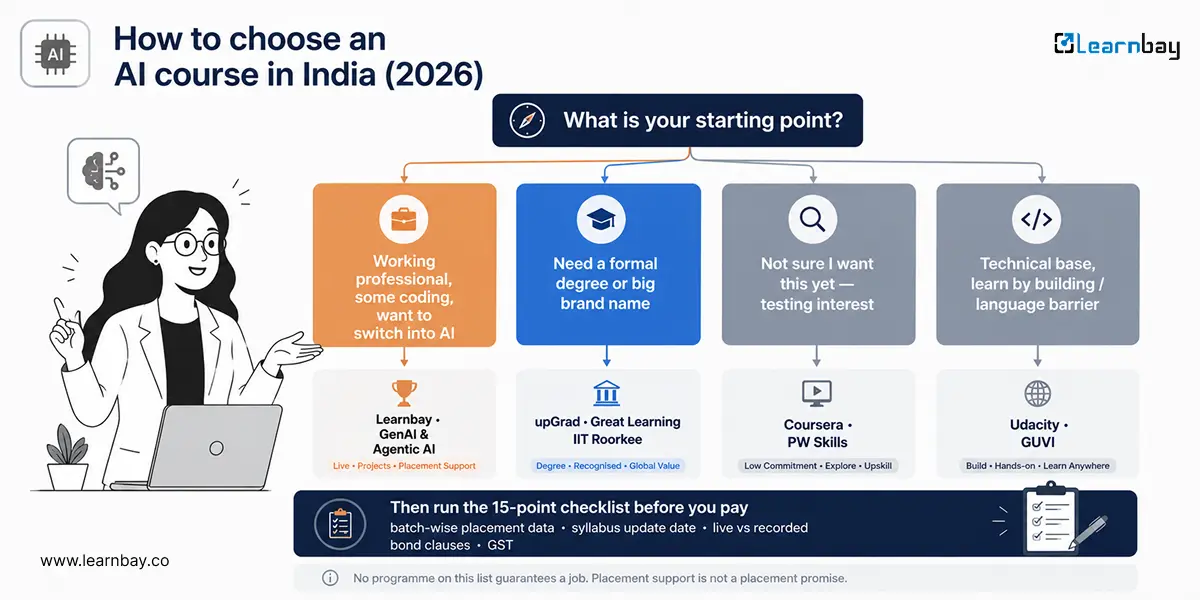
How to choose an AI course in India 2026 - decision flowchart Figure 1: How to choose the best AI course in India - match your starting point before comparing programmes.
First, Determine the Kind of Credential You Need
People are apt to overlook this step, and, understandably, many end up opting for the wrong program. There are three main types of credentials in this landscape. Each type addresses a different need and cannot be mixed.
Type 1 - Industry Certification : These programs are typically provided by training providers in partnership with a company (such as IBM or Microsoft) or an institute. They certify that the participant has completed the program and involve the development of multiple projects. The real value lies in what participants can showcase afterward, rather than the certification itself. Examples include Learnbay’s GenAI & Agentic AI Master Program, Simplilearn, GUVI, and IIT Roorkee.
Type 2 - Academic Degree : This is a master’s degree or PG diploma from a recognized university. Its value is in the degree itself: it passes HR filters, it meets employers’ requirements, and most importantly, it helps with visa and international credential evaluation-examples: upGrad’s LJMU degree and Learnbay’s MS from Woolf.
Type 3 - No-code Applied Credential : This is designed for professionals who will be using and implementing AI without the need to code and without any tech background. This type was virtually nonexistent two years ago and is now the most rapidly expanding type. This is because most of the AI work done in organizations is done by domain specialists as opposed to ML Researchers. The best example of this type is Learnbay’s Applied AI Practitioner program (certified by Vishlesan i-Hub Foundation, IIT Patna, and IBM).
I want to highlight something I discovered after some time. Nearly every company on this list specializes in a single type of offering. For example, upGrad provides degrees, Simplilearn focuses on certifications, and Coursera offers self-paced modules. While this approach can be effective as a business strategy, it also limits the advice to the specific product each provider offers.
Learnbay is one of the exceptions on this list that offers the GenAI & Agentic AI Master Program, the Applied AI Practitioner Program (offered by the Vishlesan i-Hub and IIT Patna and sponsored by IBM), and a Woolf-accredited Master of Science in Data Science and Artificial Intelligence, which is a degree that has international recognition and can be useful for people who need a credentialed degree. I'm not claiming these programs are the best, but a Learnbay counseling session can end with guidance like "choose the no-code track, or another Gen AI course," as this provides more helpful options than only offering a single product.
Before you take any counseling session , determine which of the three you actually need. If you’re still not sure, no comparison will help you.
1. Learnbay - GenAI & Agentic AI Master Program
Out of everything I looked at, the GenAI and Agentic AI Master program was the most job-focused one I could find. It helps professionals transition into an AI position within a domain that the professional is already acquainted with in the industry.
What’s Actually in It
The 9 months cover a sequence consisting of a brief intro, Python for GenAI, GenAI foundations - machine learning, Deep learning and NLP fundamentals, advanced GenAI, agentic AI and automation, LLMOps, and production deployment, plus a module dedicated to ethics, guardrails, and Responsible AI. Over 300 hours are live sessions, which, unlike most offerings, are not pre-recorded. This is the main market differentiator, and many providers often overlook it.
The updated curriculum covers overall topics including Python, TensorFlow, and Keras for foundational learning; then moves on to LangChain, LangGraph, and LangSmith; followed by AutoGen and CrewAI; Hugging Face; and Dify.ai for creating low-code agents.
The 2026 syllabus includes production-grade RAG, LLM evaluation, cloud AI, and AI deployment, plus work with Claude and the OpenAI stack. If you are comparing courses, the inclusion of LangGraph and LangSmith is a strong differentiator. These are the tools the industry has actually moved to over the past 18 months, and most other courses have not followed.
The Part That Actually Differentiates It
Most programs introduce Generative AI similarly for both BFSI and manufacturing LLM modules. However, Learnbay has a slightly different approach by organizing its content vertically.
In terms of roles: there's the SDE track for aspiring AI Engineers, QA for AI Test Engineers and AI Data Engineers, a Forward Deployed Engineer track, along with several other non-technical options. In short, it empowers professionals to master big tech skills to survive layoffs .
In terms of domain: BFSI, healthcare, e-commerce, retail, manufacturing and supply chain, HR, project management.
This is more important than it may initially appear. A QA Engineer transitioning to an AI QA Engineer is a credible and attractive move due to existing domain knowledge, as the AI component is an added layer. Conversely, a BFSI analyst seeking a role in healthcare AI faces a more challenging transition because it involves two variables, unlike those who only change one. The wiser choice is to focus on advancing within your current domain and climb the AI hierarchy there.
Programs that ignore domain context produce portfolios misaligned with specific job postings, resulting in a Kaggle telco dataset churn-prediction notebook-essentially the same project as thousands of other applicants.
AI Co-Lab
This is the feature I would highlight in an interview. Learners work on real-time problems from AI startups and earn a project certificate from the company. While not equivalent to embedded work experience, it is the closest option on this list and helps address a key challenge for career-switchers: a lack of AI work history. Although a project certificate from a startup isn’t the same as an actual job, it serves as third-party proof of project completion, unlike a graded capstone.
If you want to develop something from your own workplace, consider using the bring your own project (BYOP) option. If your employer approves, this is the most rewarding program here, allowing you to work on a project you can explore in detail and generate real business value.
What I think of it
This is the only option that I truly wish I had when making this decision. Out of all the options, this is the one I’d recommend for the person in mid-career, or someone who is a technical enthusiast who reads code.
The strength lies not in a single feature but in the alignment of all design decisions. Live classes are preferred to recorded sessions because of accountability concerns. Tracks aligned with a universal syllabus are preferred for their focus on domain-specific hiring needs. Projects are preferred to case studies because interviewers often ask follow-up questions. A 3-year flexi subscription is chosen over a fixed term to accommodate working professionals without disrupting their work-life balance.
What I’d push back on: This isn't the right program if you're looking to learn Python. However, Learnbay clearly states they do not guarantee jobs but offer placement support and referrals, with alumni working at over 350 companies. Their Career Services include help with resume writing, mock interviews, profile evaluation, and interview chances. I mention this while contemplating a comparison article that initially considers the "sure-outcomes" program as ineffective.
The honest summary: as far as prerequisites go, if you are either switching careers or starting one, this is the strongest fit on the list. If you have no experience in coding even minimally, consider enrolling in the Applied AI Practitioner Program. This oversight is among the most frequent and expensive errors I observe when selecting a program.
Who should not take this
If you're entirely new to programming and don't wish to learn it, choose the Applied AI Practitioner Program instead of the Master in AI programs. If you need a credential for visa reasons or credential assessment, opt for the Woolf-accredited MS track program.
Best for: Individuals in any career, whether tech or non-tech, with some coding skills, aiming to transition into AI. Trade-off: Real prerequisites; not a beginner program. Certification is industry-issued, not an academic degree.
Fee: ₹1,59,000 + 18% GST · Duration: 9 months · Format: 100% live, weekday or weekend batches · Certification: IBM, Microsoft, IIT Patna plus project certificates from AI startups ·
2. IIT Roorkee (E&ICT Academy) - AI & ML Certification Program
The AI & ML certification program mainly provides a genuine chance to earn IIT-certified credentials.
What’s actually in it
The program provides training on numerous topics, including Python and SQL programming, machine learning and data visualization techniques, and AI and generative AI methodologies. It offers a fully online mix of live and asynchronous teaching sessions. It is open to a wide audience, including recent graduates and working professionals, and is intended to be moderately challenging.
What I think of it
I value the program for offering a strong foundation. It effectively explains fundamental machine learning algorithms, and the IIT-affiliated syllabus adds value. Such a course is a worthwhile investment because it covers basic mathematics, which remains consistent, unlike the constantly evolving machine learning and data science frameworks.
The 8-10 hours per week commitment over 6 months for the E&ICT credential will help the participant secure interviews at various organizations where the IIT brand is valued.
Set expectations based on your specialization. This program covers broad fundamentals, not tailored for a specific industry transition. For example, BFSI professionals will learn core concepts but must build their domain knowledge independently. This approach suits freshers or learners with time to develop their fundamentals.
Most university programs, especially IITs, have credentials that are most valuable when earned on campus. Online certificates provide a credential for your resume but don't include campus placement drives. This isn't a flaw, just a feature of online programs. Knowing this can help you make an informed decision.
Who should not take this
Working professionals who need domain-specific knowledge, or who have an extensive work schedule and deadlines. Anyone relying on an online certificate for IIT campus placements should not fall into this category.
Best for freshers, students, and professionals looking to build a strong foundation in Machine Learning with IIT credentials. Trade-off: Limited role- or domain-specific specialisation, no access to placement drives for the online cohort.
Duration: 6 months, online · Commitment: ~8–10 hours/week · Certification: E&ICT Academy, IIT Roorkee · Fee: Under ₹60,000
3. upGrad - Master of Science in Machine Learning & AI (LJMU + IIIT-Bangalore)
This master’s course in ML & AI is definitely suitable for someone aiming to earn a master's degree instead of just a certificate.
What’s actually in it
You earn a Master’s degree from Liverpool John Moores University, combined with an Executive Diploma from IIIT-Bangalore / WES accreditation. Specialization tracks include MLOps, GenAI, and Agentic AI. If you’re starting with limited fundamentals, there’s a 3-month math and programming bootcamp. The program also includes over 60 case studies and more than 12 capstones, each accompanied by a dissertation. Dual specialization requires an extra three months.
What I think of it
I really believe this program is fantastic for what it aims to do, and I want to share some praise. Most of the criticism seems to come from folks who were hoping it would serve additional purposes beyond its current scope.
If an accredited master's is your goal, this pathway is worth considering. The WES accreditation is substantial, enabling immigration use and formal credential evaluations by employers. The beginner bootcamp is valuable and often absent in other programs. If your organization mandates a master's degree for promotion and salary increase, this is one of the options.
There are two things I want to bring to your attention that you must understand before enrolling, both of which people fail to understand.
The first is placements. This is an online degree with no on-campus drives at LJMU or IIIT-Bangalore, meaning no campus recruitment there. Career support is via upGrad’s placement services, which is standard. A “master’s degree from a UK university” doesn’t equate to campus recruitment or flights to the UK. Manage expectations to avoid disappointment.
The outcome highlights data science, traditional machine learning, and GenAI as a specialization in a master’s program. For quick, affordable GenAI skills within a year, an applied GenAI program is best, but for a solid machine learning qualification in 18 months, this program is better.
This program is relatively expensive, costing over ₹5,00,000, but it offers a fully accredited degree rather than a certificate. Its value depends on whether you need the degree.
Who should not take this
This program isn't suitable if you plan to change careers within the next 12 months or if your main goal is to develop agentic AIs. Do not enroll expecting guaranteed campus placements with this degree.
Best for: This program is best for someone who needs a higher degree that is internationally recognized as professional. Trade-off: This program runs through upGrad. Campus placements are also a trade-off for this program. This program is the most expensive available in this category and runs for 18 months.
Duration: 18 months (+3 for dual specialisation) · Certification: LJMU master’s degree + IIIT-B Executive Diploma, WES-accredited · Fee: Above ₹5,00,000
4. Simplilearn offers a Professional Certificate in Generative AI & Machine Learning,
This professional certificate course , provided by IIT Kanpur, is well-structured and offers a convenient alternative between a full degree and a short certificate.
What’s actually in it
This course features live virtual classes with industry experts, practical projects, and a certificate. It covers Python, data science, ML, DL, reinforcement learning, generative AI, and over 30 tools like TensorFlow, Keras, PyTorch, and LangChain.
What I think of it
Simplilearn is reliable amid many live cohort providers. Opting for an 11-month IIT Kanpur-accredited course is notable. It offers discipline and variety, appealing to those wanting a shorter course, and equips students to discuss most of the data science stack.
Two cautions, both verifiable rather than speculative.
On GenAI depth
The course offers a balanced mix of RAG, multi-agent frameworks, and LLM evaluation. While the foundational AI is solid, those preparing for agentic AI engineering should review the track syllabus, including hours on LangGraph, multi-agent orchestration, and any related projects.
On projects
This program has more than fifteen projects, which is a good number, but it lacks industry-specific domain projects. This is a strategic design choice for a general audience. You may need to create a unique project alongside broad projects to distinguish your portfolio.
Who should not take this
Anyone aiming for a role in multi-agent systems engineering or requiring a high level of specialization.
Best for: This program is best for professionals with more than two years of work experience who are looking for live and interactive training. Trade-off: This represents a compromise between extensive training and exposure to a wide range of tools, versus depth in a specific area. Additionally, it provides GenAI at different lengths depending on the chosen track.
Duration: 11 months · Format: Live online · Fee: ₹1,53,400 · Certification: EICTA Consortium, IIT Kanpur
5. Great Learning - PGP in AI & Machine Learning (UT Austin McCombs)
In collaboration with UT Austin McCombs, Great Learning has designed an AI and Machine Learning program that offers participants the experience of a full degree program.
What’s actually in it
The program begins with Python fundamentals and progresses through machine learning, deep learning, NLP, computer vision, and generative AI fundamentals over twelve months. It offers 75+ hours of live mentoring and 150+ hours of learning modules in micro-classes. Completing the program awards 9 CEUS from UT Austin McCombs, with all materials included.
What I think of it
This program transforms individuals with no programming background into deep learning and computer vision experts within a year. Its micro-class format allows instructors to identify struggles-something large webinars can't do. UT Austin McCombs certification adds international credibility -an alternative to Upgrad’s program, making it a key resume differentiator.
This program offers a quick overview of AI and ML, building a solid base without detailed coverage. It's ideal for exploring multiple areas before choosing a specialization. For focusing on production-grade GenAI systems, extra training may be necessary. The project provides insight into real-world applications; however, it is less practical than other courses.. The cost reflects UT Austin's reputation, making it a valuable investment if international recognition aids your career goals.
Who should not take this
Anyone who target for domain specialization and intends to pursue in-depth expertise in that area.
Best for: Career-Switchers with no coding background who want a globally recognised university-branded credential and solid broad coverage. Trade-off: Wide syllabus, limited time per topic, and relatively light coverage of agentic AI.
Duration: 12 months · Fee: ₹2,75,000 · Format: Online · Certification: McCombs School of Business, UT Austin (9 CEUs)
6. GUVI - Zen Class AI & ML Program
GUVI’s Zen Class AI & ML Program offers a 5-month live, project-based learning experience with industry mentorship, hands-on workshops, capstone projects, and HCL GUVI certification.
What’s actually in it
The program offers over 120 hours of live classes across 25+ modules and an IITM Pravartak-accredited certificate. All content is delivered with live weekend sessions. Notably, GUVI, now part of HCL, teaches in Indian vernacular languages.
What I think of it
This program deserves recognition for addressing an often-overlooked barrier: English-medium technical instruction. Motivation by itself isn't enough if language gets in the way of understanding. GUVI teaches in Indian vernaculars, removing an obstacle willpower can't. For Tier-2 or Tier-3 city students, it's a significant advantage to initiate learning. The weekend schedule suits full-time workers, and the IITM Pravartak certification is valuable.
Now, let's be honest—because you deserve it before you spend money.
The AI depth here is limited compared to specialised programs on this list. Coverage of advanced 2026 topics like production-grade RAG, agentic paradigms, multi-agent frameworks, fine-tuning, and LLMOps is missing. It offers a solid foundation in programming, machine learning fundamentals, and introductory AI. It's not designed to lead to an agentic AI engineering role, nor does it aim to.
Mainly, it's a well-built first step, removing language barriers for college students, beginners, and career starters. My advice: start with a low-cost, self-paced course on Udemy or Coursera to verify your interest, then use GUVI for structured fundamentals with live support in your language, before moving to a specialist program for depth. This sequence is more cost-effective than misjudging the path.
On cost, consider carefully. At 99,000 rupees, rising to 1,24,000 without a scholarship, this is close to professional-track prices-Learnbay's program costs 1,59,000 and covers fundamentals to more advanced topics. If vernacular-language teaching is essential, the fee justifies removing a barrier not addressed elsewhere. If not, compare what the same money buys elsewhere.
Who Should Not Take This
Working professionals targeting a GenAI or agentic AI role. Anyone who already has solid programming fundamentals - you would be paying for ground you have already covered.
Best for: Beginners, college students, and freshers who need live teaching in an Indian vernacular language, on weekends. Trade-off: Limited depth on advanced GenAI and agentic AI topics.
Duration: ~5-6 months · Format: Weekend online classes (Sat-Sun) in Indian vernacular languages · Certification: IITM Pravartak · Cost: ₹99,000 (with scholarship) – ₹1,24,000
7. Udacity - AI Nanodegree Programs (Agentic AI, Azure GenAI tracks)
Udacity's AI Nanodegree programs focus on specialized, project-based learning across tracks like Agentic AI and Azure Generative AI, with hands-on work centered on building, deploying, and orchestrating real-world AI solutions.
What’s actually in it
Udacity reverses the classic learning model: you build, submit, get real-person review, then revise. The main focus is on project review and mentor feedback, not a lecture library. Tracks are narrow and specific, like Agentic AI and Azure GenAI, fostering deep expertise in one area rather than broad, superficial knowledge.
What I think of it
Even without live sessions, Udacity offers something nearly unrivaled among self-paced platforms: a human reviewer who evaluates your code and provides constructive feedback. This feedback loop is fundamental to its effectiveness, which is why I consider Udacity superior to all other self-paced options on this list. You end up with deployable work you can showcase, rather than just a completion badge. It’s a cost-effective and efficient approach.
Two honest limitations.
Accountability. There are no live cohorts or fixed timeline. It suits highly self-directed learners but can stall if you're not-many overestimate their self-discipline. If you've previously dropped an online course, expect the same here unless you create external structure to stay on track.
Level. Most Nanodegree programs are designed for beginner to intermediate learners. They are effective for mastering specific AI skills and building a strong project portfolio. However, they are typically not sufficient as a pathway to a new AI career for those with no prior experience. I recommend being cautious about any claims that suggest otherwise.
Who should not take this
Anyone without a technical foundation. Anyone who has previously abandoned a self-paced course. Anyone who needs structured career support.
Best for. Self-starters with a technical base who want real portfolio depth in a specific area. Trade-off. No live contact; your success depends entirely on your own discipline.
Duration: ~3–4 months per Nanodegree · Format: Self-paced, project-based · Fee: Varies by track
8. Coursera - Generative AI for Everyone
Andrew Ng's Generative AI for Everyone on Coursera by DeepLearning.AI is a great start for beginners in GenAI. It covers applications, prompt engineering, AI projects, business impact, and responsible AI use.
What I think of it
The main weakness of this format is that people often don't finish. In my own learning experience, the courses that truly benefited me were the ones I completed. The key issue here is completion: without external accountability, most individuals struggle to see it through. There's no mentor to check in if you go silent for weeks.
Use this course to build a solid understanding, verify your interest before investing money, or to supplement a more structured program. If you plan to rely on it as your main path to a career change, pair it with a disciplined study schedule and a publicly committed project. Without such measures, the low completion rates will affect you just as much as anyone else.
Who should not take this
Anyone who needs accountability, career support, or hands-on engineering depth. Anyone treating it as a direct substitute for a structured program.
Best for: Conceptual interest verification. Conceptual aids in supplementing structured study programs. Trade-off: no live instruction, no career support, and no structured accountability.
Duration: A few hours · Format: Self-paced · Certification: DeepLearning.AI
9. PW Skills – Data Science with Generative AI
PW Skills' Data Science with Generative AI program combines Data Science, Machine Learning, Deep Learning, NLP, MLOps, and Generative AI Fundamentals through practical projects, industry-focused learning, and career assistance.
What’s actually in it
PW Skills, which acquired iNeuron following PhysicsWallah's acquisition, encompasses Python, machine learning, deep learning, NLP, and generative AI through practical projects. The program employs a hybrid format, combining pre-recorded content with live revision sessions. Tiered pricing plans with no-cost EMI options enhance accessibility, making this one of the most inclusive programs on this list.
What I think of it
The real value here is optionality, and I think it is underrated more often than it should be.
The affordability and accessibility are truly genuine, making it easy for everyone to benefit from them. For a student, a newcomer, or an individual whose current budget constrains their options, this establishment provides a legitimate starting point. I encourage someone to begin their journey here instead of holding back and not starting at all.
Where I'd manage expectations: the learning outcome leans more towards data science than generative AI and agentic AI, and the structure is lighter than in professional-track programmes. A recorded-first approach model means the responsibility for staying on track rests largely with you. For someone switching careers with a specific AI role in mind, treat this as a starting point rather than a destination, and plan your next step before you finish this one.
Regarding the pricing tiers: the 6,999 Basic plan is the most affordable option on this list to see if this type of work is suitable for you. The Pro plan at 39,999 includes job assistance. Before making a decision, verify which tier offers career support - the difference between Premium and Pro is roughly 5,000 rupees, and it's generally beneficial to pay that extra.
Who should not take this
Working professionals aiming to transition into a specific AI role. Suitable for those needing live instruction or structured accountability to remain on track.
Best for: Freshers, students, and budget-conscious learners taking a low-risk first step. Trade-off: Data-science-weighted curriculum with limited depth for a targeted AI role transition.
Duration: 8 months Format: Recorded content + Live revision sessions | Fee: ₹6,999 (Basic) / ₹34,999 (Premium) / ₹39,999 (Pro)
Here's a clear look at what you truly receive for your investment:
| Fee band | Programs | Actual fees | What’s included | What isn’t |
|---|---|---|---|---|
| Free – ₹60,000 | Coursera, Udacity, PW Skills, IIT Roorkee | ₹6,999–₹39,999 (PW Skills); under ₹60,000 (IIT Roorkee) | Self-paced or lightly live content, completion certificates, some project review. IIT Roorkee adds an institute-branded credential | Live mentoring at depth, structured career support, accountability |
| ₹60,000 – ₹2,00,000 | Learnbay, Simplilearn, GUVI | ₹99,000–₹1,24,000 · ₹1,53,400 · ₹1,59,000 | Live mentor-led sessions, industry certifications, real projects, career services. Learnbay adds AI Co-Lab startup projects and BYOP | A formal academic degree |
| ₹2,00,000 – ₹3,00,000 | Great Learning | ₹2,75,000 | Global university credential, live mentoring, small cohorts, alumni network | Deep specialisation in a single AI sub-field |
| Above ₹5,00,000 | upGrad | Above ₹5,00,000 | Accredited master’s degree, WES portability, dual subject specialisation | Speed. And campus placement access |
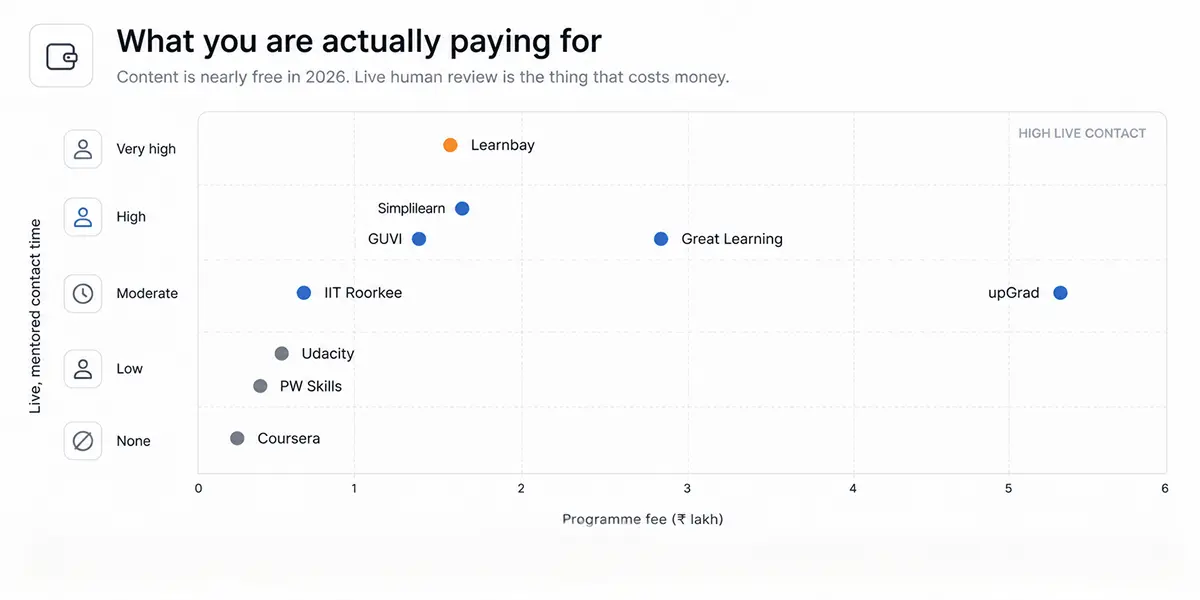
AI course prices in India 2026 don't reflect mentored contact time
Figure 2: Cost of AI courses in India versus contact time.
Looking at the middle band. Simplilearn is ₹1,53,400, Learnbay is ₹1,59,000 and GUVI is between ₹99,000 - ₹1,24,000. Each of the three courses targets a different audience and provides varying depths of content. Though priced similarly, they offer distinct value, so there's little link between cost and worth within this price range. Lowering the price has limited impact if the course only addresses a small part of the skills needed for your potential job. The major price disparities occur at the extremes. PW Skills costs ₹6,999, while upGrad exceeds ₹5,00,000 - a 70x difference. This gap indicates a real distinction: one offers a low-risk option to try out, and the other provides an accredited degree. This pattern is consistent throughout the market: you're paying for live interaction and accountability, not for the content. Content itself is almost free now - the entire Andrew Ng catalog costs only a few thousand rupees. The real expense is having someone review your work and tell you it's not good enough yet or the cost spikes if you are not able to complete the course in the designated subscription period. The real question behind "is this course worth ₹1.5 lakh?" is more specific: "How many hours of expert human attention do I receive, and under what conditions?" Ask providers directly for that figure. The reputable ones will respond promptly.
Cost vs value analysis
I created this section because I once watched someone sign an agreement they had never read, and I want to make sure that does not happen to you. No-cost EMI can be quite helpful if it truly is free of additional charges. Verify if the listed price is consistent whether you pay upfront or through installments. If the total EMI amount is higher, the extra cost is effectively interest under a different name. Request both figures in writing for clarity.
Income Share Agreements and bonds. Some providers in the wider market-beyond those listed-include clauses that obligate you to accept certain job placements or give up a portion of your future salary. Carefully review all clauses related to post-course obligations. If a provider is reluctant to share the agreement before you pay, that reluctance signals an important warning.
Scholarships and early-bird pricing are more prevalent than providers often acknowledge, and they are seldom promoted explicitly. Inquire proactively. The worst outcome is that the price remains unchanged.
Curriculum Depth. This is the location of the 2026 Topics
Here is the comparison I wish I had when I started: it shows how comprehensively each programme addresses the topics listed in 2026 job ads. The ratings are based on my review of the published syllabi as of August 2026. Keep in mind, syllabi may change, so verify details before enrolling.
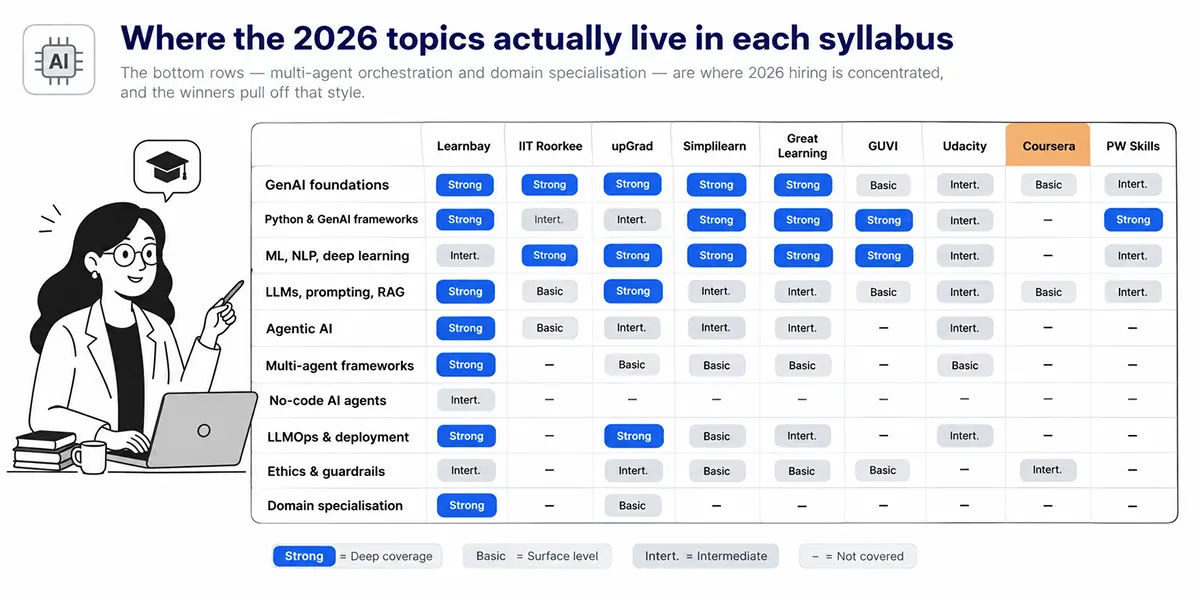
Curriculum comparison of the top AI courses in India 2026
Figure 3: GenAI and agentic AI topic depth across all nine AI courses in India.
| Program | Strongest coverage | Adequate | Light or absent |
|---|---|---|---|
| Learnbay | LLMs & Production RAG, Agentic AI, multi-agent frameworks (LangGraph, CrewAI, AutoGen), LLMOps, production, domain specialisation, no-code agents | ML/NLP/deep learning, ethics & guardrails | Light on ML/DL |
| IIT Roorkee | GenAI foundations, ML, NLP, deep learning | Python & GenAI frameworks | Agentic AI, LLMOps, domain specialisation |
| upGrad | GenAI foundations, ML/NLP/DL, LLMs & RAG, LLMOps | Agentic AI, ethics, Python frameworks | Multi-agent frameworks, domain specialisation |
| Simplilearn | GenAI foundations, Python frameworks, ML/NLP/DL | LLMs & RAG, agentic AI | Multi-agent frameworks, LLMOps, domain specialisation |
| Great Learning | GenAI foundations, Python frameworks, ML/NLP/DL, computer vision | LLMs & RAG, agentic AI, LLMOps | Multi-agent frameworks, domain specialisation |
| GUVI | Python frameworks, ML/NLP/deep learning | GenAI foundations, LLMs, ethics | Agentic AI, multi-agent frameworks, LLMOps, fine-tuning |
| Udacity | Varies by track - strong within the chosen Nanodegree | GenAI, agentic AI, LLMOps, Python frameworks | Ethics, domain specialisation |
| Coursera | Conceptual GenAI literacy, ethics | LLM fundamentals | Hands-on frameworks, agentic AI, LLMOps |
| PW Skills | Python frameworks | GenAI foundations, ML/NLP/DL, LLMs & RAG | Agentic AI, multi-agent frameworks, LLMOps |
A close evaluation of the table above shows that most training institutes provide limited or no coverage of multi-agent frameworks, agentic AI, LLMOps, ethical principles, and hands-on agentic modeling. On the other hand, Learnbay has strong coverage of Agentic AI frameworks and concepts, empowering professionals to learn and lead the AI age in 2026. Therefore, ask when the syllabus was provided and request the framework names to check whether the course is worth investing in for upskilling in 2026.
What should be included in a Gen AI portfolio by the year 2026?
This is the section I would have found most valuable, so I have put more into it than any other part. Everything above is about choosing a course. This part is about what you actually need to walk away with.
One production-shaped project, not five notebooks. Interviewers can spot the difference immediately. A single project with error handling, evaluation, cost tracking, and a deployment story is worth more than five Colab notebooks that stop at model.fit(). The phrase "production-shaped" is carrying real weight here - the project does not have to handle real traffic, but it has to look like something that genuinely could.
A RAG system where you can explain the retrieval failures. Nearly everyone builds a RAG chatbot these days. Almost nobody can answer the question "what happens when the retriever returns three irrelevant chunks?" Being able to talk through chunking strategy, embedding choice, reranking, and failure modes is what separates a real portfolio project from a tutorial you just followed along with.
An agent that does something with real consequences. Multi-step, tool-calling, with an actual API on the other end. Then be ready for the follow-up questions: what stops it from looping forever, what is the cost ceiling, what happens when the tool call fails? Agentic AI interviews are built almost entirely around these questions.
Evaluation, written down. How do you know your system actually improved? If your answer is "it seemed better," you will lose out to a candidate who has an eval set and a concrete number. LLM evaluation is the fastest-growing gap between what courses teach and what employers actually want.
Domain framing. A generic project on "Churn prediction on a telco dataset" will allow you to compete with thousands of professionals. On the other hand, a domain-specific project, "Claims triage for a mid-size health insurer, with the regulatory constraints built into the design", will help you validate your uniqueness and transition into AI roles. Hence, domain-specific AI learning is advised for several professionals to re-establish their careers with attractive wage premiums in 2026 and beyond.
A written record. A short blog post or README that documents what you tried, what failed, and what you changed. It is evidence of engineering judgment rather than tutorial completion. It is exactly the kind of thing a colleague once showed me that made everything click. If you don’t receive these after completing a program, the specific company’s certificate doesn’t matter. Confirm with the counselor which of the elements the program includes.
What domain-specific AI operations actually look like
Domain-specific AI upskilling or role-based upskilling is advantageous for professionals willing to transition their careers into AI roles. However, it does not necessarily mean switching out of your existing domain or undervaluing related skills. Professionals can have domain-specific AI upskilling to continue in their existing domain but with a lucrative wage premium.
Switching from a particular domain often underestimates the specialized skills required there. Consider the actual responsibilities involved in AI roles within sectors that typically draw career changers.
BFSI is heavily constrained by documentation and regulation, making it a good fit for RAG systems. The key work activities include claim triage, extraction of KYC documents, summarization of fraud patterns, categorization of advisory co-pilots for relationship managers, and monitoring of regulatory changes. In this sector, what truly gets you noticed is your ability to discuss how a user can review their auditable work/system/decision trail to identify how to refine/expand the controls (which is accurate to 2 decimal places), as opposed to engineers from outside the BFSI domain, who may not think of this as an important design constraint.
Healthcare includes documentation, automation of prior authorizations, summarization of communication with patients, and assistance with medical coding. In this domain, hallucination presents a major risk, which means substantive compliance (designing with guardrails and keeping the human in the loop) is a core competency as opposed to a compliance afterthought. This is an area with nearly irreplaceable domain knowledge.
Manufacturing and supply chain include predictive maintenance, quality inspections, monitoring of supplier risks, forecasting of demand, and a growing number of agents that read shipping documents and exceptions. This is the area that my colleague’s project focused on. This area gives an advantage to those who can describe the real impact of a production line going down.
E-commerce and retail focus on enhancements to product catalogs, improvements to search, personalized merchandising, reviews, and customer service agents. This sector is the most advanced of all sectors when it comes to GenAI, so there are opportunities to work in this sector; however, there is a great deal of competition.
HR and operations include automatic, unbiased review of resumes, development of internal company policies, and employee analysis and mining of company data. This sector has a great deal of scrutiny related to data accuracy and fairness, and, as a result, truly knowing ethics and having guardrails will differentiate you.
The pattern in all five sectors is the same: models are not typically the limiting factor. The important skills are finding challenges worth your time and determining what is correct in different contexts. These are your strengths, and a novice graduate does not have them. These are also the reasons why domain-specific programs that you are thinking about taking are infinitely more valuable than general programs because of your years of experience. This is why I placed the greatest emphasis on domain-specific programs for my rankings.
AI salaries in India (2026): stop looking at averages
The most misleading figure in any AI salary video in India is the average. Usually, if someone receives an offer of ₹80 LPA, it significantly raises the average, but most graduates actually earn much less. Using ranges provides a clearer picture.
These ranges are derived from Glassdoor, AmbitionBox, and Naukri, and should be verified against current job listings in your specific location and role, as these ranges can vary considerably.
| Role | Entry (0–3 yrs) | Mid (3–8 yrs) | Senior (8+ yrs) |
|---|---|---|---|
| Jr. Data Scientist / AI Analyst | ₹4–8 LPA | ₹14–18 LPA | ₹20 LPA+ |
| Data Scientist | ₹6–9 LPA | ₹12–22 LPA | ₹50 LPA+ |
| ML Engineer | ₹4–10 LPA | ₹10–20 LPA | ₹22–45 LPA |
| GenAI Engineer | ₹5–9 LPA | ₹12–30 LPA | ₹30–60 LPA |
| AI Agent Developer | ₹5–12 LPA | ₹12–30 LPA | ₹30–50 LPA (leads: ₹80 LPA+) |
| AI/ML Lead | - | ₹35–45 LPA | ₹50–80 LPA |
| AI Architect | ₹14–24 LPA | ₹25–45 LPA | ₹50 LPA+ |
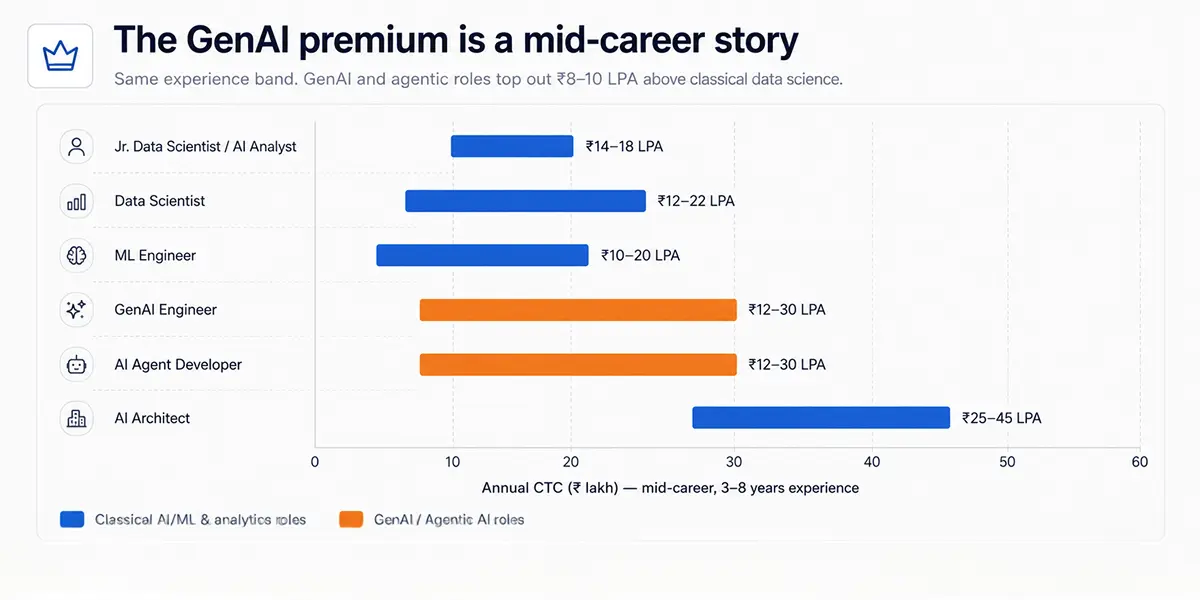
AI and GenAI salary ranges in India 2026 by role Figure 4: Mid-career Indian AI salary ranges: GenAI and agentic roles vs. classical AI/ML roles.
Let's focus on the mid-career rows. Data Scientists and GenAI Engineers with similar experience can earn as much as ₹8–10 LPA more. This highlights why choosing a syllabus that emphasizes GenAI and agentic AI over traditional ML makes sense in 2026. It also supports PwC’s finding that AI-related roles offer salaries that are 62% higher.
How AI hiring in India works in 2026
The process, when analyzed, helps one understand what needs to be prioritized.
Step 1 - Automated resume screening. Consistency in brand names and keywords is crucial at this stage. Credentials from IBM, Microsoft, Google, IITs and other universities are particularly advantageous, as resumes are typically subjected to only 10-15 seconds of manual review in this phase.
Step 2 - Technical screening. This phase includes evaluating knowledge in programming, SQL, and other ML fundamentals. For GenAI roles, a new baseline question has been added: "Explain how a RAG pipeline works."
Step 3 - Interview Round - You describe your project. The interviewer probes into it, testing your understanding. Tutorial projects typically exhaust their answers in about 4 minutes. For real projects with debugging, the interview concludes once the interviewer has no more questions.
Step 4 - You need to respond to the case study and explain how your solution addresses the identified problem. Individuals with practical, real-world experience tend to explain and analyze case studies more effectively than engineers with only a strong background in computer science. This is why a domain-mapped capstone is significantly more valuable than a traditional one.
Step 5 is mostly straightforward. However, expect questions about responsible automation, AI hallucination in automation, and how much work you are willing to automate.
In short, a Recruitment credential advances you to Step 1, while a Project moves you through Steps 3 and 4. The most common mistake is optimizing for one at the expense of the other. If possible, I recommend pursuing both.
Is an IIT or university certificate worth more than a live industry program?
This was the most frequent question, so I'll be direct: they address different issues, and most people focus on the wrong priorities.
Having an approved institutional name can assist in the screening process. For a recruiter reviewing 400 applications, brand recognition can serve as a filter, and an IIT or university affiliation often helps the application pass initial screening more frequently for a fresher or college student. This is a genuine benefit that I will not overlook.
Understanding what being credentialed truly entails involves nuances. A university or IIT credential mainly benefits you during campus stays and recruitment drives when recruiters visit the campus. An online certification adds value to your resume and is particularly helpful during resume screenings, though it has less impact during the actual recruitment events. Most of the plans listed follow a similar recruitment pattern, even if it's not explicitly mentioned.
Screenings aren’t where offers come in. According to TestGorilla’s State of Skills-Based Hiring 2025, 85% of employers now seek skills-based hiring, up from 81% in 2024, and 53% no longer require degrees, up from 30%. In interviews, the focus is on your projects.
It’s important to note that the numbers and statistics quoted in marketing course materials are often misrepresented. The same report says that only 32% of employers say that degrees matter less than they did 5 years ago, while 41% say that they matter more. Therefore, it is not correct to say that degrees don’t matter. What it indicates is that recruiting skills have been introduced as an additional criterion in the course, whereas having a degree is still a criterion.
Almost always, a technical interview will value a portfolio of projects in your industry over a certificate. Certificates simply won't impress hiring managers during a technical interview. Buying a domain-mapped program to mentor you through your career will help you stand out from your competitors during the tech job application process. You will see the best results if you buy this program in combination with a credential that will help you clear the initial vetting stage, even if it is not recognised in the industry. This program is absolutely a worthwhile investment.
AI course vs M.Tech vs IIT executive program vs self-learning
The two questions I kept circling back to were “why not just do an M.Tech?” and “is self-learning enough?”
| Factor | Live industry-focused AI program | Full-time M.Tech (AI/CS) | IIT executive program | Self-paced roadmap |
|---|---|---|---|---|
| Duration | 4–13 months | 2 years | 6–18 months | Open-ended |
| Keep your job? | Yes | No | Yes | Yes |
| Role relevance | High - domain and role-mapped | Moderate - research-oriented | Moderate - fundamentals-first | Depends entirely on you |
| Certification | Industry-backed (IBM, Microsoft, etc.) | University degree | IIT / IIIT credential | Generic or none |
| Typical cost | ₹75,000 – ₹2,50,000+ | ₹2–25 lakh plus 2 years of forgone salary | ₹50,000 – ₹9,00,000 | Free – ₹5,000 |
| Mentorship | High - structured, live | Academic supervision | Moderate | None |
| Accountability | High | High | Moderate–high | Low |
| Placement access | Provider career services | University placement drives | Varies; often limited for online cohorts | None |
| Best for | Professionals switching into AI roles | Freshers and aspiring researchers | Professionals wanting IIT credentials without quitting | Motivated learners supplementing other study |
My practical take. For early-career folks who can take a two-year time-out for a formal PG degree, an M.Tech seems feasible. The real cost is the fee and the two years of probably lost pay. At ₹40 lakh (which is a mid-career estimate), this causes most folks to rule it out, even before looking more closely.
An IIT Executive program suits someone around the 5-year experience mark who values brand and fundamentals over self-learning, but faster.
Self-learning, while valuable for exploration and supplementing knowledge, tends to have a low completion rate. It's also not very effective as a primary method for career changes-it's not that the content is inadequate, but because no one notices when you cease learning.
For the primary goal of a career change, the most important and best tool is an industry-specific program that includes industry-specific domain specialisation or role-based specialization to help you build a portfolio. Of course, you must put in the work. Any provider who claims otherwise is selling an unrealistic product.
The six mistakes I observed people make:
1. The most common error is buying a syllabus built for another type of person. A syllabus designed for a career fresher should look drastically different from one for a career switcher. Clearly identify for whom a program is made before thinking about what it offers.
2. Prioritise brand reputation over effort. A recognised credential helps your resume pass initial screening but doesn't assist in answering technical questions in the project round. Candidates who focus on brand rather than skills often come with impressive resumes but have weak portfolios.
3. Assuming prerecorded content can replace live instruction is a misconception. “300 hours of content” and “300 hours of live teaching” are not the same. It's important to understand what you are purchasing and to consider what occurs when you have a question at 9 PM on a Tuesday.
4. Changing two variables at the same time. Changing domain and function simultaneously (BFSI to healthcare AI) approximately doubles the complexity level. Change the function, keep the domain constant. Do not discard your existing domain knowledge.
5. Beware of programs promising 'guaranteed placements.' No program can ensure employment, as hiring decisions are outside their control. Providers claiming to guarantee placements often use tricky legal tactics or include hidden fine print that you might not notice. Instead, request data broken down by batches for better clarity.
6. The most common failure is not finishing. This isn't related to the course quality. If you've only completed part of a self-paced course, seek accountability-join a live cohort, set a fixed schedule, or find a mentor to monitor your progress. This is the best predictor of success.
The 14-point checklist I’d use before paying anyone
Print this. Ask these questions on the counselling call. How a provider answers is itself information.
Curriculum
- Does the syllabus cover topics that will be relevant in 2026 and beyond, including agentic AI, RAG, LLMOps, or is it limited to prompt engineering?
- When was the syllabus last updated?
- Check if new frameworks like LangGraph or LangSmith are added in syllabus.
- Do you have a domain-specific or role-specific track, or a universal one?
Training
- Are sessions truly live, or recorded with a live doubt-clearing call?
- What happens if you miss a session: recording, make-up class or nothing?
- Are there weekday and weekend batch options, and can you switch?
Certification
- What does the partner brand really certify: the whole program or one module?
- Do you get a separate project completion certificate?
- Does the credential indicate placement-based access, or is it just a resume credential? (Typically the latter for online programs - be sure to have them specified.)
Career support
- Which companies have recently hired graduates, and what positions did they fill?
- Does “placement support” refer to targeted outreach or a resume blast to a mailing list?
Cost and Terms
- Is the quoted price including GST? And is no-cost EMI genuinely free of cost?
- Are there any bonds, clauses, or income-share agreements? Request the agreement before making a payment.
How to Select the Right AI Course in India for You
The key takeaway from this article is that there is no universally best AI course in India. The ideal course depends on your current knowledge and starting point. The nine courses listed earlier are genuine options, but each may be unsuitable for some individuals.
Just answer these four questions in the order they’re listed. Doing so will help you find the answers more quickly than sifting through a comparison table.
1. What is the goal that you are looking to achieve?
Examples include getting a job, changing careers, getting promoted, earning a degree, or learning to read and write. Switching careers requires courses with live instruction and a domain-specific portfolio. Not getting fired immediately may need AI literacy for now, not deep AI engineering. AI literacy can cost less than ₹10,000.
2. Will the goal that you are trying to achieve require programming skills on your part?
This one question eliminates most of the courses on the list. The courses offered by Learnbay, GenAI, and the Agentic AI Master Program expect you to learn programming and technical skills. If you do not intend to learn programming skills, you should opt for the Applied AI Practitioner Program, which is a no-code track, rather than an engineering course, even if it is discounted.
3. What is your actual weekly time availability each week?
Be realistic this time. 8 to 12 hours a week is what an average working professional can manage. Fewer hours won't help with a 12-month program, and an 18-month degree will suffer even more.
4. Does your desired role require GenAI or classical ML depth?
Review ten active job postings for your target role and track the frameworks mentioned. If you're interested in frameworks like LangGraph, CrewAI, RAG, and LLMOps, choose a curriculum focused on GenAI and Agentic AI. However, if your focus includes frameworks such as scikit-learn, forecasting, and model evaluation, a broader machine learning program would be more appropriate.
Once you answer these four, you are often left with a couple of choices. After that, ask both institutions for batch-wise placement details and an updated syllabus, and choose the one that provides them without hesitation.
How I'd Actually Decide
Rather than asking which AI course is the best in India, consider which option suits you best.
-
If you have 5-15 years of experience in a non-AI field and want to transition to AI, you need to choose your domain and take role-based, live classes with a mentor and a capstone. This is the gap that Learnbay’s GenAI & Agentic AI Master Program addresses. If you don’t intend to code, the way to the same destination is the Applied AI Practitioner Program (IIT Patna Vishlesan i-Hub, certified by IBM).
-
If you need a reputed name or a formal degree, the options are the upGrad LJMU + IIIT-B program or Learnbay’s Woolf-accredited MS or Great Learning’s UT Austin program.
-
If you do not have a strong preference for this field, you can use PW Skills or Coursera at a very low cost (7,000 Rupees per month), compared with the 150,000 Rupees and 9 months that the other programs ask for.
-
If you enjoy building things and have a background in tech, the Nanodegrees offered by Udacity will be a better choice than other, more lecture-centric academic programs. If you need a more structured program, pair it with one.
-
If your most significant barrier is to face instruction in English. Vernacular-language weekend classes offered by GUVI remove the barrier that no amount of motivation can tackle. One can build a foundation in these classes and then move on to a specialised programme for greater depth.
Glossary: The 2026 terms that will be on every syllabus
Agentic AI - autonomous systems that are able to execute a series of tasks, call tools and APIs, and act upon a set of goals.
RAG (Retrieval-Augmented Generation) - an LLM that answers not based on the model’s training data, but rather by providing relevant text documents. “Production-grade RAG” includes reranking, evaluation, and failure handling. Ask which RAG system is taught that includes all of these components.
Multi-agent frameworks - In 2026, you can expect syllabi to cover LangGraph, CrewAI, and AutoGen, along with tools for orchestrating several cooperating agents.
LLMOps - In 2026, LLM deployment comprehensively covers monitoring, version control, and cost. This is possibly the most important but least taught concept on this list.
LLM evaluation - Measuring performance and outcomes to determine the effectiveness of the system. Be prepared to answer this in an interview.
Fine-tuning - In contrast to 2026, in 2023 this was a central concept in any conversation. RAG and prompting tend to solve enterprise cases in a cost-effective way.
Guardrails - These systems ensure that the output is compliant and safe and does not violate any regulations. Required in BFSI and Healthcare.
MCP (Model Context Protocol) - An emerging system that connects models to tools, and teaching this language indicates the curriculum is current.
Forward Deployed Engineer - An engineer responsible for deploying and integrating AI systems within the customer's environment. This title is rapidly emerging in 2026.
Key Takeaways
There is no single best AI course in India. The best AI course in India depends on your starting point, your constraints, and the job role you aim for. Those who get this wrong usually do so at the matching stage, not the effort stage.
If you're exploring IIT fundamentals, IIT Roorkee is an ideal choice. For budget-friendly options, PW Skills or Coursera are suitable. For recognized, portable degrees, consider upGrad or a Woolf-accredited MS. GUVI offers flexible learning in your language. Udacity helps you build portfolios. Great Learning is suitable for obtaining reputable, global university credentials without coding experience. Simplilearn provides partner credentials from structured bootcamps.
If you're a professional with a technical background who's interested in building and shipping AI systems, join Learnbay’s GenAI & Agentic AI Master Program-I endorse it. IIT Patna’s Vishlesan i-Hub Foundation and IBM also offer pathways without prior programming that lead to similar outcomes. I appreciate both for providing training aligned with what companies actually seek, rather than what’s easy to teach or in high demand.
Whatever decision you make, remember to keep what my colleague demonstrated. Nobody was hired for the certificate itself; he was hired for what he could demonstrate-rebuild and explain the failure cases. You should enroll in the program that will likely give you a certification or proof of completion to show them.
Frequently Asked Questions
What is the best AI course in India for working professionals in 2026?
For professionals looking to switch to AI, Learnbay’s GenAI & Agentic AI Master Program stands out on this list. The program is 100% live, offers role-based learning tracks for SDE, QA, Forward Deployed Engineer, and non-tech roles, and includes domain-aligned capstones, AI Co-Lab startup projects, and IBM and Microsoft certifications. It costs INR 1,59,000 + GST and requires previous knowledge of Python, ML, and deep learning.
What is the best AI course in India in 2026?
There is no one single best AI course in India. It varies according to an individual's starting point. For working professionals looking to switch to AI, Learnbay’s GenAI & Agentic AI Master Program (INR 1,59,000 + GST, 9 months, 100% live) comes out the strongest on this list. For an IIT credential, IIT Roorkee’s E&ICT program at approx INR 60,000. For an accredited degree, upGrad’s LJMU master’s. For a global university brand without coding, Great Learning’s UT Austin program at INR 2,75,000.
How do I choose the best AI course in India for my career?
The first step is identifying what outcome you expect from the course. Do you wish to switch jobs, get promoted, learn for the sake of learning, or obtain a degree? Do you have any coding skills? How many hours a week can you dedicate to the course? Do the roles you desire to apply for require depth in classical ML or GenAI? Lastly, what is your budget, including GST? After that, check the syllabus of 10 live job postings you see for the role you wish to apply for and see if the course teaches the required frameworks.
How much is an AI course in India in 2026?
The price range for AI courses in India is roughly between 6,999 INR and over 5,00,000 INR. Some self-paced beginner options cost around 6,999 INR (PW Skills). IIT Roorkee's certification costs less than 60,000 INR. Live professional courses cost between 99,000 INR to 1,59,000 INR (Simplilearn - 1,53,400 INR, Learnbay - 1,59,000 INR). Great Learning's UT Austin program costs 2,75,000 INR. upGrad offers an accredited master's degree program above 5,00,000 INR. Make sure the course price listed includes the 18% GST.
What is the best AI course for beginners or on a tight budget?
For cost, I believe Coursera's Generative AI for Everyone is the best starting point. For beginners with a tighter budget, PW Skills has some great structured plans.
Which AI course is best for non-technical professionals who don’t want to code?
For these individuals, I recommend exploring no-code and low-code programs. One suitable option is Learnbay's Applied AI Practitioner Program, a certified, 4-month mentor-led course focused on using AI tools, automating workflows, and deploying agentic AI without traditional programming. It targets professionals in BFSI, HR, Marketing, Operations, and Product.
Do AI courses in India guarantee a job?
No, and one should call into question any provider who claims otherwise. Read the fine print for bonds, income-share agreements, or clauses that can tie you to low-paid placements. Good programs offer placement support, which includes help with resumes and mock interviews, to increase your chances of placement without a guarantee.
How long does it take to prepare for a job in AI?
Most live AI programs take 4-13 months. An applied, project-focused course can get you job interview-ready in about 4-6 months. Comprehensive programs take about 9-12 months. Self-paced courses take a long time to complete because they have no fixed completion time.
What is the difference between GenAI and a traditional AI/ML course?
Traditional AI/ML focuses on data and algorithms, as well as regression analysis and classification. GenAI and agentic AI focus on LLMs, prompts, RAG, and other pipelines, as well as the use of smart agents that deploy tools to perform several tasks. While agentic AI is the most rapidly growing area of hiring in 2026, this is still the best area to learn classical ML before continuing to build on LLM systems.
What is agentic AI and why is it on almost all 2026 syllabi?
Agentic AI is focused on the development of systems that perform tasks like prompting, calling APIs, and goal-directed action, rather than tasks that provide single-step responses. It is the most rapidly growing area of hiring in 2026, as the primary use cases of Gen AI in the enterprise are agent-based workflows. Frameworks like LangGraph, CrewAI, AutoGen, and MCP should be on your syllabus.
Which AI course focuses on agentic AI and multi-agent systems?
According to the information presented, Learnbay’s GenAI & Agentic AI Master Program goes the deepest on this list. It covers LangGraph, LangSmith, AutoGen, CrewAI, and Dify.ai, which have real-world deployments and evaluations of LLMs. Udacity’s Agentic AI Nanodegree program is good, but more on the shallow side. Most of the other AI programs focus on building multi-agent systems and offer only a superficial understanding of agentic AI.
Are Coursera or Udemy self-paced courses even close to sufficient for a complete career change?
I wouldn’t really say so. They both help build a foundation, but most people don’t complete them. I wouldn’t advise using either on their own for a career change. Combine them with a live, project-based course at the very least, or maintain a scheduled project and a goal you’ve made a public commitment to achieve.
Do I need a computer science degree to apply for an AI course in India?
No. Most GenAI/ML and professional AI programs accept candidates from various educational backgrounds and require a good understanding of logic and numerical ability. No-code programs completely remove the barrier. Check the pre-reqs carefully. Some applied GenAI programs presume previous knowledge of Python and ML (Machine Learning).
Is learning classical machine learning a requirement before diving into GenAI?
Definitely not. Most professional programs start by walking through regression and classification and how to evaluate models. LLMs are built on those same concepts. Most professional programs start by walking through those concepts. The AI systems you can use are plenty, but to actually build, you have to have the building concepts of AI, specifically ML and NLP.
What should I ask a provider that offers “guaranteed placement”?
Request batch-based data on placement instead of cumulative data, the median instead of the average package, the names of companies that hired the last two batches and the roles they hired for, a clear meaning of “placement support”, and the details of any bond or income-share agreement. A good provider will answer all five questions without any trouble.
Will a certificate from IIT or a university get me placement during the campus drives?
Generally speaking, no, if you are doing an online program. Campus placement drives are typically reserved for on-campus students. An online certificate from an IIT or a university is a resume credential; useful at the screening stage, but it doesn't grant placement. Make sure they say that.
Is an online Master’s Degree worth it when compared to a Certification?
That once again depends on what issue you are trying to solve. A degree stops visa issues, credential evaluation, or an employer with a firm position on degrees from being an obstacle (firmly accredited options are upGrad’s LJMU degree and Woolf-accredited programs, which use the European ECTS credit system). If you need to make a career shift in under twelve months, a certification plus a strong portfolio is fast and costs less.
How much can you expect AI professionals to earn in India in 2026?
GenAI Engineers, AI Agent Developers, and Data Scientists with 3-8 years work experience earn between ₹12 and ₹30 LPA, ₹12 to ₹22 LPA, respectively. Senior GenAI roles fall in the range of ₹30 to ₹60 LPA, and AI leads can earn up to ₹50 to ₹80 LPA. Ignore the citation of ‘average package’ figures. Ask for the median and the batch-wise data instead.
Is it possible to pursue an AI course while working full-time?
Most of the programs in this list are designed to facilitate working learners. So, it can be done. Opt for schemes that have weekend batches, live classes with recordings, and a duration that is more than what you can spare. Learnbay have designed their 3-year membership option and Saturday-Sunday structure, respectively, to accommodate the same constraint. The realistic time commitment is 8-12 hours per week.
What do placement support and placement guarantee offered with AI courses mean?
With placement support, students receive help with resume building, mock interviews, and other profile optimization and lead-generation services, offering real help with an uncertain outcome. With a placement guarantee, a working relationship is promised, and that rarely survives the ‘fine print’. A placement guarantee means you should cross-check the document you are signing thoroughly; it is not a promise.
How can you verify if the testimonials posted on a course's site are real?
Alumni with a consistent work history that indicates the transition the course claims are real users and can be verified. Look for testimonials posted on Course Report, SwitchUp, Quora, and Reddit. You should ask to speak with current learners who are not featured in the marketing materials.